Elasmobranchii (haaien en roggen) (sharks and rays) >
Rajiformes (Skates and rays) >
Arhynchobatidae (Softnose skates)
Etymology: Bathyraja: Greek, bathys = deep + Latin, raja, -ae = a ray (Raja sp) (Ref. 45335); aguja: Named for its type locality, off Point Aguja, Peru.
Milieu: milieu / Klimaatzone / Diepte / verspreidingsgebied
Ecologie
marien bathydemersaal; diepte 650 - 980 m (Ref. 127873). Deep-water
Southeast Pacific: Peru.
Grootte / Gewicht / Leeftijd
Maturiteit: Lm ? range ? - ? cm
Max length : 76.0 cm TL mannelijk / geslacht onbekend; (Ref. 127873)
Korte beschrijving
Determinatiesleutels | Morfologie | Morfometrie
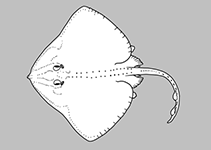
This species have two symmetrically arranged, large, white spots on the dorsal surface at the pectoral-fin bases and symmetrically arranged white spots along the disc margins and this pattern is consistent at all sizes from small to at least 76.0 cm TL in adult males; it has a uniformly colored ventral surface without spots or patterning; anterior disc margin distinctly undulating; preorbital length times orbital length 3.70; preorbital length times interorbital length 2.81; interorbital space times orbit length 1.30; orbital length times spiracle length 1.65; pre-oral length times internarial length 2.12; the dorsal disc surface with a median row of thorns originating from behind shoulder girdle on disc; thorns regularly arranged; median thorns 30-33; interdorsal thorn 1-2; the dermal denticles on the dorsal disc surface mostly smooth except for small patches of widely spaced dermal denticles on snout, between orbits, and tail; teeth arranged in quincunx; predorsal tail vertebrae 62-66; pectoral-fin radial count 80-83 (Ref. 127873).
Cross section: flattened.
Oviparous (Ref. 50449). Eggs have horn-like projections on the shell (Ref. 205).
Levenscyclus en paargedrag
Maturiteit | Voortplanting | Paaien | Eieren | Fecunditeit | Larven
Oviparous, paired eggs are laid. Embryos feed solely on yolk (Ref. 50449). Eggs have horn-like projections on the shell (Ref. 205).
McEachran, J.D. and K.A. Dunn, 1998. Phylogenetic analysis of skates, a morphologically conservative clade of elasmobranchs (Chondrichthyes: Rajidae). Copeia 1998(2):271-290. (Ref. 27314)
Status op de Rode Lijst van het IUCN (Ref. 130435: Version 2025-2 (Global))
Gevaar voor de mens
Harmless
Gebruik door de mens
Tools
Speciale rapporten
Download XML
Internetbronnen
Schattingen op basis van modellen
Fylogenetische diversiteitsindex (Ref.
82804): PD
50 = 0.5000 [Uniqueness, from 0.5 = low to 2.0 = high].
Bayesian length-weight: a=0.00562 (0.00296 - 0.01067), b=3.13 (2.97 - 3.29), in cm total length, based on LWR estimates for this Genus-body shape (Ref.
93245).
Trofisch niveau (Ref.
69278): 3.9 ±0.7 se; based on size and trophs of closest relatives
Weerstandsvermogen (Ref.
120179): laag, minimale populatieverdubbelingstijd 4,5-14 jaar (Fec assumed to be <100).
Kwetsbaarheid van de visserij (Ref.
59153): Moderate to high vulnerability (50 of 100).
🛈