Klassifizierung / Names
Namen | Synonyme | Catalog of Fishes(Gattung, Arten) | ITIS | CoL | WoRMS | Cloffa
Umwelt: Milieu / Klimazone / Tiefenbereich / Verbreitungsgebiet
Ökologie
seewasser riff-verbunden; tiefenbereich 0 - 293 m (Ref. 6773), usually 19 - 20 m (Ref. 90102). Subtropical; 40°N - 50°S, 1°W - 147°W (Ref. 57374)
Eastern Atlantic: Azores, Madeira, the Canary Islands, and St. Helena. Indo-Pacific: Red Sea, Persian Gulf and East Africa to the Hawaiian and Society islands, north to Japan, south to New Zealand.
Größe / Gewicht / Alter
Geschlechtsreife: Lm ? range ? - ? cm
Max length : 13.0 cm TL Männchen/unbestimmt; (Ref. 4113)
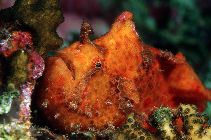
Rückenflossenstacheln (insgesamt) : 3; Rückenflossenweichstrahlen (insgesamt) : 12 - 13; Afterflossenstacheln: 0; Afterflossenweichstrahlen: 7 - 8. Color variable, yellow, pink, red, brown, or black. a dark spot at base of posterior dorsal rays (a black phase with tips of pectoral rays white also occurs, Ref# 1602). Illicium about equal in length with 2nd dorsal spine. Bulbous esca with filamentous tentacles (resembling a stout-bodied shrimp, Ref# 1602). Last pelvic fin ray bifurcate. Caudal peduncle present. Eyes usually with bands radiating from its pupil (Ref. 48635).
Body shape (shape guide): short and / or deep; Cross section: compressed.
Sedentary (Ref. 68964). Inhabit intertidal zone to depths of at least 25 m on both lagoon and seaward reefs. May be taken anywhere from the surface to approximately 176 m in the Indo-Pacific area, average depth of known captures at 19 m. Those from Eastern Atlantic at deeper waters, between 44 and 293 m, average depth of 107 m. In life, its esca resembles a tiny stout-bodied shrimp (Ref. 37816). Benthic (Ref. 58302). Oviparous. Eggs are bound in ribbon-like sheath or mass of gelatinous mucus called 'egg raft' or 'veil' (Ref. 6773). Voracious carnivore, attracting prey with front of their cavernous mouth by wriggling their baitshaped first dorsal spine (lure) (Ref. 68964).
Lebenszyklus und Paarungsverhalten
Geschlechtsreife | Fortpflanzung | Ablaichen | Eier | Fruchtbarkeit | Larven
Oviparous. Eggs are bound in ribbon-like sheath or mass of gelatinous mucus called 'egg raft' or 'veil' (Ref. 6773).
Pietsch, T.W. and D.B. Grobecker, 1987. Frogfishes of the world. Systematics, zoogeography, and behavioral ecology. Stanford University Press, Stanford, California. 420 p. (Ref. 6773)
IUCN Rote Liste Status (Ref. 130435: Version 2025-2 (Global))
Bedrohung für Menschen
Harmless
Nutzung durch Menschen
Fischereien: nicht kommerziell
Tools
Zusatzinformationen
Download XML
Internet Quellen
Schätzungen auf der Grundlage von Modellen
Bevorzugte Temperatur (Ref.
123201): 24.2 - 29, mean 28.2 °C (based on 110 cells).
Phylogenetischer Diversitätsindex (Ref.
82804): PD
50 = 0.5020 [Uniqueness, from 0.5 = low to 2.0 = high].
Bayesian length-weight: a=0.02692 (0.01067 - 0.06789), b=2.96 (2.73 - 3.19), in cm total length, based on LWR estimates for this (Sub)family-body shape (Ref.
93245).
Trophische Ebene (Ref.
69278): 4.2 ±0.73 se; based on food items.
Widerstandsfähigkeit (Ref.
120179): hoch, Verdopplung der Population dauert weniger als 15 Monate. (Fec = 48,800).
Anfälligkeit der Fischerei (Ref.
59153): Low vulnerability (10 of 100).
🛈
Nährstoffe (Ref.
124155): Calcium = 38.1 [15.9, 94.0] mg/100g; Iron = 0.643 [0.318, 1.325] mg/100g; Protein = 19.2 [16.7, 22.5] %; Omega3 = 0.22 [0.08, 0.60] g/100g; Selenium = 14.5 [5.5, 39.2] μg/100g; VitaminA = 146 [33, 675] μg/100g; Zinc = 0.755 [0.435, 1.248] mg/100g (wet weight);