This website uses cookies to enhance your browsing experience and ensure the functionality of our site. For more detailed information about the types of cookies we use and how we protect your privacy, please visit our Privacy Information page.
×
Cookie Settings
This website uses different types of cookies to enhance your experience. Please select your preferences below:
メクラウナギ (hagfishes) > Myxiniformes (Hagfishes) > Myxinidae (Hagfishes) > Myxininae
Etymology: Myxine:Ancient Greek word for a slimy fish: myxa, slime; -inus, one who, referring to copious amounts of slime produced by M. glutinosa (See ETYFish); knappi:In honor of American ichthyologist Leslie W. Knapp (1929-2017), National Museum of Natural History, Smithsonian Institution, for supplying the authors with study material (See ETYFish). Eponymy: Dr Leslie William Knapp (1929–2017) was an ichthyologist at the Department of Vertebrate Zoology, National Museum of Natural History, Smithsonian. [...] (Ref. 128868), visit book page.
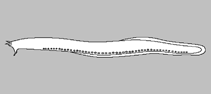
This species is distinguished by the following characters: with a 2-cusp multicusp on both the anterior and posterior sets of cusps; gill pouches 6 on each side; tail slime pores 11-14; total slime pores 116-123; rostrum broadly rounded; ventral finfold nearly vestigial; color pinkish-blue, head and barbels slightly paler than body (Ref. 31699). Body shape (shape guide): eel-like.
Copulatory organ absent. The gonads of hagfishes are situated in the peritoneal cavity. The ovary is found in the anterior portion of the gonad, and the testis is found in the posterior part. The animal becomes female if the cranial part of the gonad develops or male if the caudal part undergoes differentiation. If none develops, then the animal becomes sterile. If both anterior and posterior parts develop, then the animal becomes a functional hermaphrodite. However, hermaphroditism being characterised as functional needs to be validated by more reproduction studies (Ref. 51361 ).
Fernholm, B., 1998. Hagfish systematics. p. 33-44. In J.M. Jørgensen, J.P. Lomholt, R.E. Weber and H. Malte (eds.) The biology of hagfishes. Chapman & Hall, London. 578 p. (Ref. 31276)
IUCNのレッドリストの状況は (Ref. 130435: Version 2025-2 (Global))
系統多様性指数 (参照 82804): PD50 = 0.5000 [Uniqueness, from 0.5 = low to 2.0 = high].
Bayesian length-weight: a=0.00115 (0.00045 - 0.00294), b=3.03 (2.81 - 3.25), in cm total length, based on LWR estimates for this (Sub)family-body shape (Ref. 93245).
栄養段階 (参照 69278): 3.4 ±0.6 se; based on size and trophs of closest relatives
回復力 (参照 120179): 低い, 4.5年~14年の倍増期間の最小個体群 (Fec assumed to be <100).
漁業の脆弱性 (Ref. 59153): Moderate vulnerability (43 of 100). 🛈