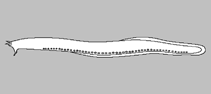
Myxini (pirålar) (hagfishes) >
Myxiniformes (Hagfishes) >
Myxinidae (Hagfishes) > Eptatretinae
Etymology: Eptatretus: hepta (Gr.), seven; tretos (Gr.), perforated (i.e., with holes), referring to seven gill apertures on what would later be described as Homea banksii (=E. cirrhatus) [range within genus is 6-14 pairs of gill apertures] (See ETYFish); chinensis: -ensis, Latin suffix denoting place: China, specifically South China Sea off southeastern Taiwan, type locality (See ETYFish).
Miljö: miljö / Klimatzon / djupintervall / distributionsområde
Ekologi
marina djupbottenlevande; ej vandrande; djupintervall ? - 600 m (Ref. 31276). Deep-water
Western Pacific: South China Sea.
Storlek / Vikt / Ålder
Könsmognad: Lm ? range ? - ? cm
Max length : 37.5 cm TL hane/ej könsbestämd; (Ref. 31276)
Kort beskrivning
Bestämningsnycklar | Morfologi | Morfometri
The species has 6 pairs of gill pouches and apertures. Gill apertures in a straight line, not crowded. Eyespots prominent. Fused cusps 3/3, 8-10 unicusps each row, total cusps 46-52. Slime pores: prebranchial 15-19 + branchial 4-5 + trunk 42-45 + tail 11-14. It is distinguished from the other 3 Asian species on Eptatretus by having 6 rather than 7 or 8 pairs of gill pouches (Ref. 51420).
Body shape (shape guide): eel-like.
Maximum depth from Ref. 58018.
Livscykel och parningsbeteende
Könsmognad | Reproduktion | Lek | Ägg | Fekunditet | Larver
Copulatory organ absent. The gonads of hagfishes are situated in the peritoneal cavity. The ovary is found in the anterior portion of the gonad, and the testis is found in the posterior part. The animal becomes female if the cranial part of the gonad develops or male if the caudal part undergoes differentiation. If none develops, then the animal becomes sterile. If both anterior and posterior parts develop, then the animal becomes a functional hermaphrodite. However, hermaphroditism being characterised as functional needs to be validated by more reproduction studies (Ref. 51361 ).
Fernholm, B., 1998. Hagfish systematics. p. 33-44. In J.M. Jørgensen, J.P. Lomholt, R.E. Weber and H. Malte (eds.) The biology of hagfishes. Chapman & Hall, London. 578 p. (Ref. 31276)
Status på IUCN:s rödlista (Ref. 130435: Version 2025-2 (Global))
Hot mot människor
Harmless
Mänskliga användningsområden
Fiskeri: saknar intresse
Verktyg
Särskilda rapporter
Ladda ner XML
Internet-källor
Uppskattningar baserade på modeller
Index för fylogenetisk mångfald (Ref.
82804): PD
50 = 0.5000 [Uniqueness, from 0.5 = low to 2.0 = high].
Bayesian length-weight: a=0.00204 (0.00094 - 0.00444), b=2.92 (2.72 - 3.12), in cm total length, based on LWR estimates for this (Sub)family-body shape (Ref.
93245).
Trofisk nivå (Ref.
69278): 4.1 ±0.7 se; based on size and trophs of closest relatives
Resiliens (Ref.
120179): Låg, lägsta populationsfördubblingstid 4,5-14 år (Fec assumed to be <100).
Sårbarhet i fisket (Ref.
59153): Low to moderate vulnerability (28 of 100).
🛈