Élasmobranches (requins et raies) (sharks and rays) >
Rajiformes (Skates and rays) >
Rajidae (Skates)
Etymology: Amblyraja: Greek, amblys = darkness + Latin, raja, -ae = ray (Raja sp.) (Ref. 45335).
Eponymy: Professor Martin Doello-Jurado (1884–1948) was a marine biologist and malacologist, who was also interested in palaeontology. [...] (Ref. 128868), visit book page.
Environnement : milieu / zone climatique / profondeur / gamme de distribution
Écologie
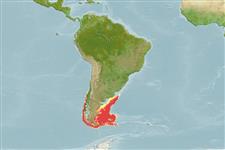
marin démersal; profondeur 50 - 640 m (Ref. 114953). Subtropical; 35°S - 57°S, 78°W - 53°W (Ref. 114953)
Southeast Pacific: Chile (Ref. 27540, Ref. 114953). Southwest Atlantic: off Argentina (Ref. 26282) and Uruguay, including Falkland Islands (Ref. 58839, Ref. 114953).
Taille / Poids / Âge
Maturité: Lm ? range ? - ? cm
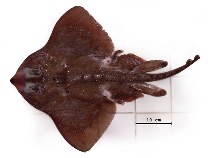
Max length : 69.0 cm TL mâle / non sexé; (Ref. 114953)
Found on mid- and outer continental shelf and upper slope, occasionally caught deeper to 1000 m. Mainly feeds on benthic invertebrates and small bony fishes (Ref. 114953). Oviparous. Distinct pairing with embrace. Young may tend to follow large objects, such as their mother (Ref. 205). Eggs are oblong capsules with stiff pointed horns at the corners deposited in sandy or muddy flats (Ref. 205). Egg capsule measures 86.4 mm long and 56.2 mm wide (Ref. 41249). Hatches from egg case at ca. 9 cm TL (Ref. 114953).
Cycle de vie et comportement reproducteur
Maturité | Reproduction | Frai | Œufs | Fécondité | Larves
Oviparous. Distinct pairing with embrace. Young may tend to follow large objects, such as their mother (Ref. 205). Paired eggs are laid. Embryos feed solely on yolk (Ref. 50449).
McEachran, J.D. and K.A. Dunn, 1998. Phylogenetic analysis of skates, a morphologically conservative clade of elasmobranchs (Chondrichthyes: Rajidae). Copeia 1998(2):271-290. (Ref. 27314)
Statut dans la liste rouge de l'IUCN (Ref. 130435: Version 2025-2 (Global))
Menace pour l'homme
Harmless
Utilisations par l'homme
Outils
Articles particuliers
Télécharger en XML
Sources Internet
Estimations basées sur des modèles
Température préférée (Réf.
123201): 4.5 - 9, mean 7.3 °C (based on 65 cells).
Indice de diversité phylogénétique (Réf.
82804): PD
50 = 0.5039 [Uniqueness, from 0.5 = low to 2.0 = high].
Bayesian length-weight: a=0.00302 (0.00141 - 0.00645), b=3.24 (3.07 - 3.41), in cm total length, based on LWR estimates for this (Sub)family-body shape (Ref.
93245).
Niveau trophique (Réf.
69278): 4.1 ±0.2 se; based on size and trophs of closest relatives
Résilience (Réf.
120179): Faible, temps minimum de doublement de population : 4,5 à 14 années (Fec assumed to be <100).
Vulnérabilité de la pêche (Ref.
59153): Moderate to high vulnerability (48 of 100).
🛈