Elasmobranchii (Haie und Rochen) (sharks and rays) >
Orectolobiformes (Carpet sharks) >
Hemiscylliidae (Bamboo sharks)
Etymology: Chiloscyllium: cheilos (Gr.), lip, referring to membranous and broad lower lip, presumably of C. plagiosum (proposed without a species); skylion, Greek for dogfish or small shark (See ETYFish); hasseltii: In honor of Dutch physician and biologist Johan Coenraad van Hasselt (1797-1823), who explored the colonial Dutch East Indies with his friend Heinrich Kuhl in 1820 (See ETYFish).
Eponymy: Dr Johan Coenraad van Hasselt (1797–1823) was a Dutch physician, zoologist, botanist and mycologist. [...] (Ref. 128868), visit book page.
More on author: Bleeker.
Umwelt: Milieu / Klimazone / Tiefenbereich / Verbreitungsgebiet
Ökologie
seewasser riff-verbunden; tiefenbereich 0 - 12 m (Ref. 90102). Tropical; 23°N - 10°N, 91°E - 133°E
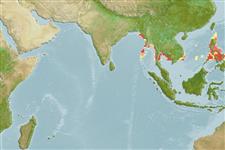
Indo-West Pacific: Thailand, Singapore, Malaysia, Indonesia, Myanmar and Vietnam.
Größe / Gewicht / Alter
Geschlechtsreife: Lm ? range ? - ? cm
Max length : 61.0 cm TL Männchen/unbestimmt; (Ref. 106604)
Rückenflossenstacheln (insgesamt) : 0; Afterflossenstacheln: 0. Caudal fin with a pronounced subterminal notch but without a ventral lobe (Ref. 13575). Juveniles with dark grey-brown bands outlined in black, adults uniform medium- to dark-brown color, the black edgings being the last parts of the color pattern to disappear (Ref. 13575).
Body shape (shape guide): elongated.
A common inshore bottom-dweller (Ref. 13575); on rock and coral reefs (Ref. 90102). Feeds on invertebrates (Ref. 13575). Oviparous (Ref. 50449). Utilized for human consumption (Ref. 13575). Minimum depth from Ref. 58018.
Lebenszyklus und Paarungsverhalten
Geschlechtsreife | Fortpflanzung | Ablaichen | Eier | Fruchtbarkeit | Larven
Oviparous, paired eggs are laid. Embryos feed solely on yolk (Ref. 50449). Distinct pairing with embrace (Ref. 205).
Compagno, L.J.V. and V.H. Niem, 1998. Hemiscylliidae. Longtail carpetsharks. p. 1249-1259. In K.E. Carpenter and V.H. Niem (eds.) FAO identification guide for fishery purposes. The Living Marine Resources of the Western Central Pacific Vol. 2. Rome: FAO. (Ref. 13575)
IUCN Rote Liste Status (Ref. 130435: Version 2025-2 (Global))
Bedrohung für Menschen
Harmless
Nutzung durch Menschen
Fischereien: kommerziell
Tools
Zusatzinformationen
Download XML
Internet Quellen
Schätzungen auf der Grundlage von Modellen
Bevorzugte Temperatur (Ref.
123201): 27.9 - 29.1, mean 28.7 °C (based on 158 cells).
Phylogenetischer Diversitätsindex (Ref.
82804): PD
50 = 0.5039 [Uniqueness, from 0.5 = low to 2.0 = high].
Bayesian length-weight: a=0.00407 (0.00182 - 0.00914), b=3.09 (2.89 - 3.29), in cm total length, based on LWR estimates for this (Sub)family-body shape (Ref.
93245).
Trophische Ebene (Ref.
69278): 3.5 ±0.37 se; based on food items.
Widerstandsfähigkeit (Ref.
120179): niedrig, Verdopplung der Population dauert 4,5 - 14 Jahre. (Fec assumed to be <100).
Anfälligkeit der Fischerei (Ref.
59153): Moderate vulnerability (44 of 100).
🛈