>
Siluriformes (Catfishes) >
Ariidae (Sea catfishes) > Ariinae
Etymology: Cathorops: Greek, kathorao = to observe, to watch + Greek, ops = appearance (Ref. 45335).
More on author: Meek.
Entorno: milieu / zona climática / rango de profundidad / gama de distribución
Ecología
; agua dulce; salobre demersal. Tropical
Central America: Atlantic draining rivers from Panuco River basin in Mexico to Izabal Lake in Guatemala (Ref. 58032). Materials examined from río Usumacinta and
lago Izabal basins, formerly treated as Cathorops aguadulce (e.g. Castro-Aguirre et al., 1999; Miller et al., 2005; Betancur-R. and Willink, 2007), are treated as Cathorops kailolae(Ref. 75004). Examination of more materials is needed to determine whether the population reported from other localities reported by Miller et al., 2005 from other localities (i.e. río Panuco, río Tecolutla, río Coatzacoalcos, and Gulf of Mexico) should be separated (Ref. 75004).
Tamaño / Peso / Edad
Madurez: Lm ? range ? - ? cm
Max length : 22.7 cm SL macho / no sexado; (Ref. 75004)
Descripción breve
Claves de identificación | Morfología | Morfometría
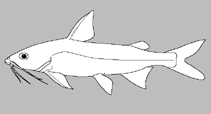
Espinas dorsales (total) : 1; Radios blandos dorsales (total) : 7; Radios blandos anales: 21. Differs from all other species of Cathorops by having the following features: fleshy papillae intercalated with gill rakers on first two gill arches; posterior margin of pectoral-fin spine with long and conspicuous serrations (except in Cathorops kailolae, Cathorops melanopus, Cathorops multiradiatus, and Cathorops tuyra); gill rakers on first arch 14-16; and snout length 9.3-11.6% SL. Can be further separated from Cathorops belizensis by its longer supraoccipital process 11.5-16.3% SL (vs. 8.8-10.5% SL), larger orbital diameter 4.6-6.9 % SL (vs. 3.6-4.4% SL), and shorter interorbital distance 9.9-12.3 (vs. 12.9-15.1% SL); from Cathorops higuchii by its gill rakers on second arch 13-16 (vs. 17-21), and larger orbital diameter 4.6-6.9 (vs. 3.3-4.4% SL); from Cathorops kailolae by its longer distance from tip of snout to dorsal-fin origin 39.0-40.7 (vs. 33.1- 38.0% SL); from Cathorops mapale species group by its gill rakers on second arch 13-16 (vs. 17-21); from Cathorops melanopus by its longer distance from tip of snout to dorsal-fin origin 39.0-40.7 (vs. 30.0-32.6% SL), and longer distance from tip of snout to posterior margin of dorsomedian groove of neurocranium 22.9-26.4 (vs. 17.9-19.1% SL) (Ref. 75004).
Body shape (shape guide): elongated.
Found in large to medium-sized rivers, lagoons and small drainages. Typically inhabits freshwaters, but may also occur in marine waters (Ref. 75004).
Ciclo vital y comportamiento de apareamiento
Madurez | Reproducción | Puesta | Huevos | Fecundidad | Larva
Marceniuk, A.P. and R. Betancur-R, 2008. Revision of the species of the genus Cathorops (Siluriformes: Ariidae) from Mesoamerica and the Central American Caribbean, with description of three new species. Neotrop. Ichthyol. 6(1):25-44. (Ref. 75004)
Situación en la Lista Roja de la UICN (Ref. 130435: Version 2025-2 (Global))
Amenaza para el ser humano
Traumatogenic (Ref. 58010)
Usos humanos
Pesquerías: comercial
Herramientas
Informes especiales
Descargar XML
Fuentes de Internet
Estimaciones basadas en modelos
Índice de diversidad filogenética (Referencia
82804): PD
50 = 0.5000 [Uniqueness, from 0.5 = low to 2.0 = high].
Bayesian length-weight: a=0.00468 (0.00245 - 0.00892), b=3.13 (2.96 - 3.30), in cm total length, based on LWR estimates for this (Sub)family-body shape (Ref.
93245).
Nivel trófico (Referencia
69278): 4.3 ±0.8 se; based on size and trophs of closest relatives
Resiliencia (Referencia
120179): Alto, población duplicada en un tiempo mínimo inferior a 15 meses (Preliminary K or Fecundity.).
Vulnerabilidad pesquera (Ref.
59153): Low vulnerability (18 of 100).
🛈