Umwelt: Milieu / Klimazone / Tiefenbereich / Verbreitungsgebiet
Ökologie
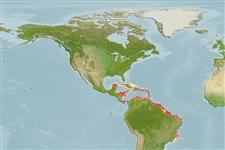
seewasser; brackwasser benthopelagisch; ozeanodrom (Ref. 51243); tiefenbereich 0 - 50 m (Ref. 189). Tropical; 23°N - 25°S, 90°W - 32°W (Ref. 189)
Western Atlantic: in the Antilles, from Cuba and perhaps throughout; Guatemala south and east to Venezuela and Trinidad, south to just north of Rio de Janeiro, Brazil).
Größe / Gewicht / Alter
Geschlechtsreife: Lm ? range ? - ? cm
Max length : 30.0 cm TL Männchen/unbestimmt; (Ref. 37032); common length : 17.0 cm TL Männchen/unbestimmt; (Ref. 5217)
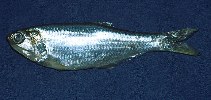
Rückenflossenstacheln (insgesamt) : 0; Afterflossenstacheln: 0; Afterflossenweichstrahlen: 25 - 32. Snout short and pointed, tip at about eye center; maxilla moderate, tip pointed and reaching onto pre-operculum (but not beyond), extending beyond second supra-maxilla; sub-operculum with angular hind margin, but not formed into a triangular projection; lower gill rakers increasing in large fishes. Anal fin origin below front few dorsal fin rays. Silver stripe disappearing with age (Ref. 189).
Body shape (shape guide): fusiform / normal; Cross section: oval.
Found inshore forming quite large schools and also in estuaries, mangroves and other lagoons, penetrating into almost freshwater (salinities of 4.9-32.25 ppt in Santa Cruz Canal, Pernambuco, Brazil). Feeds by filtering plankton. No data on spawning.
Lebenszyklus und Paarungsverhalten
Geschlechtsreife | Fortpflanzung | Ablaichen | Eier | Fruchtbarkeit | Larven
Spawn in school (Ref. 205).
Whitehead, P.J.P., G.J. Nelson and T. Wongratana, 1988. FAO Species Catalogue. Vol. 7. Clupeoid fishes of the world (Suborder Clupeoidei). An annotated and illustrated catalogue of the herrings, sardines, pilchards, sprats, shads, anchovies and wolf-herrings. FAO Fish. Synop. 125(7/2):305-579. Rome: FAO. (Ref. 189)
IUCN Rote Liste Status (Ref. 130435: Version 2025-2 (Global))
Bedrohung für Menschen
Harmless
Nutzung durch Menschen
Fischereien: weniger kommerziell; Köder: usually
Tools
Zusatzinformationen
Download XML
Internet Quellen
Schätzungen auf der Grundlage von Modellen
Bevorzugte Temperatur (Ref.
123201): 26.4 - 28.1, mean 27.5 °C (based on 172 cells).
Phylogenetischer Diversitätsindex (Ref.
82804): PD
50 = 0.5625 [Uniqueness, from 0.5 = low to 2.0 = high].
Bayesian length-weight: a=0.00513 (0.00405 - 0.00649), b=3.17 (3.10 - 3.24), in cm total length, based on LWR estimates for this species (Ref.
93245).
Trophische Ebene (Ref.
69278): 3.4 ±0.45 se; based on food items.
Widerstandsfähigkeit (Ref.
120179): hoch, Verdopplung der Population dauert weniger als 15 Monate. (Preliminary K or Fecundity.).
Anfälligkeit der Fischerei (Ref.
59153): Low vulnerability (20 of 100).
🛈
Nährstoffe (Ref.
124155): Calcium = 127 [64, 285] mg/100g; Iron = 1.09 [0.58, 2.01] mg/100g; Protein = 18.1 [16.6, 19.7] %; Omega3 = 0.405 [0.204, 0.884] g/100g; Selenium = 53.2 [27.5, 113.0] μg/100g; VitaminA = 34.3 [8.5, 97.2] μg/100g; Zinc = 1.5 [1.0, 2.2] mg/100g (wet weight);