Elasmobranquios (tiburones y rayas) (sharks and rays) >
Rhinopristiformes (Shovelnose rays) >
Rhinobatidae (Guitarfishes)
Eponymy: Henry von Prahl (1948–1989) was a pioneering Colombian marine biologist who studied Gorgona Island (the type locality) and whose family emigrated from Germany (1953). He was killed by a bomb, which exploded on Avianca Airlines Flight 203 over Bogotá. (Ref. 128868), visit book page.
Entorno: milieu / zona climática / rango de profundidad / gama de distribución
Ecología
marino demersal; rango de profundidad ? - 70 m (Ref. 26282). Tropical; 14°N - 6°S, 92°W - 82°W (Ref. 114953)
Eastern Pacific: from Mexico and from north-western Costa Rica to northern Peru.
Tamaño / Peso / Edad
Madurez: Lm ? range ? - ? cm
Max length : 90.0 cm TL macho / no sexado; (Ref. 101827); peso máximo publicado: 1.4 kg (Ref. 37888)
Descripción breve
Claves de identificación | Morfología | Morfometría
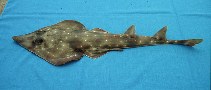
Rostral cartilage distally enlarged; anterior nasal prolongations reaching medial margin of nostrils; posterior margin of spiracle with 2 folds, the medial one rudimentary; a line of about 77 prickles between nuchal region and first dorsal fin; 3 or 4 prickles on shoulders, few tubercles on snout and small prickles on anterior margin of orbits; body covered dorsally with about 80 white dots (3 to 5 mm in diameter) over a brown body; underbody white except snout with a black diamond shape blotch, extending backward laterally (Ref. 13259).
Body shape (shape guide): elongated.
Living individuals reported to be in sandy and rocky environments near coral-reefs at 18-24 m depth of the Colombian coast (Ref. 101827). In contrast the type specimen was taken from a depth of 70 m (Ref. 26282). Ovoviviparous (Ref. 50449). Males mature at ca. 71 cm TL (Ref. 114953).
Ciclo vital y comportamiento de apareamiento
Madurez | Reproducción | Puesta | Huevos | Fecundidad | Larva
Exhibit ovoviparity (aplacental viviparity), with embryos feeding initially on yolk, then receiving additional nourishment from the mother by indirect absorption of uterine fluid enriched with mucus, fat or protein through specialised structures (Ref. 50449).
Compagno, L.J.V., 1999. Checklist of living elasmobranchs. p. 471-498. In W.C. Hamlett (ed.) Sharks, skates, and rays: the biology of elasmobranch fishes. Johns Hopkins University Press, Maryland. (Ref. 35766)
Situación en la Lista Roja de la UICN (Ref. 130435: Version 2025-2 (Global))
Amenaza para el ser humano
Harmless
Usos humanos
Pesquerías: sin interés
Herramientas
Informes especiales
Descargar XML
Fuentes de Internet
Estimaciones basadas en modelos
Índice de diversidad filogenética (Referencia
82804): PD
50 = 0.5020 [Uniqueness, from 0.5 = low to 2.0 = high].
Bayesian length-weight: a=0.00282 (0.00168 - 0.00474), b=3.10 (2.95 - 3.25), in cm total length, based on LWR estimates for this species & Genus-body shape (Ref.
93245).
Nivel trófico (Referencia
69278): 3.6 ±0.5 se; based on size and trophs of closest relatives
Resiliencia (Referencia
120179): Bajo, población duplicada en un tiempo mínimo de 4.5-14 años (Fec assumed to be <100).
Vulnerabilidad pesquera (Ref.
59153): High vulnerability (56 of 100).
🛈