>
Acanthuriformes (Surgeonfishes) >
Chaetodontidae (Butterflyfishes)
Etymology: Chaetodon: Greek, chaite = hair + Greek, odous = teeth (Ref. 45335).
Eponymy: Jacob Theodor Klein (1685–1759) was a German jurist, historian, botanist, zoologist and mathematician. His publications on fishes include: Historiae Piscium Naturalis promovendae Missus primus Gedani (1744). (Ref. 128868), visit book page.
More on author: Bloch.
Ambiente: milieu / zona climática / intervalo de profundidade / gama de distribuição
Ecologia
marinhas associadas(os) a recifes; não migratória (Ref. 52884); intervalo de profundidade 0 - 90 m (Ref. 128797), usually 10 - ? m (Ref. 1602). Tropical; 30°N - 32°S, 29°E - 130°W
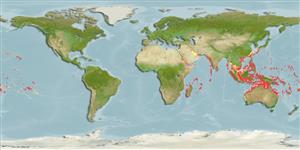
Indo-West Pacific: Red Sea and East Africa (south to Coffee Bay, South Africa, Ref. 5372) to the Hawaiian Islands and Samoa, north to southern Japan, south to New South Wales, Australia and New Caledonia. Eastern Pacific: Galapagos Islands (Ref. 5227).
Tamanho / Peso / Idade
Maturidade: Lm ? range ? - ? cm
Max length : 15.0 cm TL macho/indeterminado; (Ref. 5372)
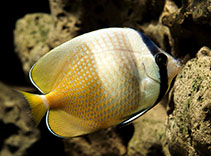
Espinhos dorsais (total) : 13 - 14; Raios dorsais moles (total) : 20 - 23; Espinhos anais: 3; Raios anais moles: 17 - 20; Vértebras: 24. Body is yellowish brown with two broad white vertical bars running across the body one from near the origin of the dorsal spine and the other from the middle of the back. A black bar runs vertically across the eye. There are numerous dotted horizontal stripes on the sides. The margin of caudal fin is transparent (Ref. 4855). Snout length 2.5-3.2 in HL. Body depth 1.5-1.8 in SL (Ref. 90102).
Body shape (shape guide): short and / or deep; Cross section: compressed.
Adults occur in deeper lagoons and channels, and seaward reefs (Ref. 1602). Benthopelagic (Ref. 58302). Depth 2-61 m, usually below 10 m (Ref. 90102). They Occur singly or in pairs (Ref. 37816). Common, omnivorous individuals that feed mainly on soft coral polyps (mainly on Sarcophyton tracheliophorum and Litophyton viridis), algae and zooplankton. Oviparous (Ref. 205). Form pairs during breeding (Ref. 205).
Ciclo de vida e comportamento de acasalamento
Maturidade | Reprodução | Desova | Ovos | Fecundidade | Larvas
Distinct pairing (Ref. 205). Monogamous mating is observed as both obligate and social (Ref. 52884).
Myers, R.F., 1991. Micronesian reef fishes. Second Ed. Coral Graphics, Barrigada, Guam. 298 p. (Ref. 1602)
Categoria na Lista Vermelha da IUCN (Ref. 130435: Version 2025-2 (Global))
Ameaça para o homem
Harmless
Utilização humana
Pescarias: pescarias de subsistência; Aquário: Espécies comerciais
Ferramentas
Relatórios especiais
Descarregue XML
Fontes da internet
Estimativas baseadas em modelos
Temperatura preferida (Ref.
123201): 24.7 - 29, mean 27.8 °C (based on 832 cells).
Índice de diversidade filogenética (Ref.
82804): PD
50 = 0.5000 [Uniqueness, from 0.5 = low to 2.0 = high].
Bayesian length-weight: a=0.03090 (0.01873 - 0.05100), b=3.04 (2.90 - 3.18), in cm total length, based on LWR estimates for this species & Genus-body shape (Ref.
93245).
Nível Trófico (Ref.
69278): 2.9 ±0.2 se; based on diet studies.
Resiliência (Ref.
120179): Elevada, tempo mínimo de duplicação da população menor que 15 meses (Preliminary K or Fecundity.).
Vulnerabilidade da pesca (Ref.
59153): Low vulnerability (10 of 100).
🛈
Nutrientes (Ref.
124155): Calcium = 113 [58, 170] mg/100g; Iron = 0.887 [0.532, 1.450] mg/100g; Protein = 18.4 [17.3, 19.6] %; Omega3 = 0.122 [0.073, 0.199] g/100g; Selenium = 38.6 [21.2, 72.4] μg/100g; VitaminA = 45.2 [12.4, 160.4] μg/100g; Zinc = 1.6 [1.1, 2.3] mg/100g (wet weight);