>
Gobiiformes (Gobies) >
Oxudercidae (Mudskippers) > Periophthalminae
Etymology: Periophthalmus: Greek, peri = around + Greek, ophthalmos = eye (Ref. 45335).
Taxonomic Remarks
Eschmeyer (CofF ver. Sep. 2011: Ref. 88002) recognizes Periophthalmus cantonensis (Osbeck, 1765) as valid on the basis of Cyprinus ccantonensis Osbeck, 1865 after several publications posterior to Murdy (1989: Ref. 5218) but without mentioning the later author that we follow here, The original description must be re-assessed as there is few chances that it is a Gobiidae. See Murdy (1989) for the history of that name.
Environnement : milieu / zone climatique / profondeur / gamme de distribution
Écologie
marin; eau douce; saumâtre démersal; amphidrome (Ref. 46888). Subtropical
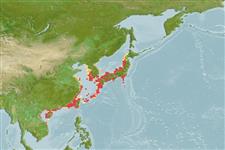
Northwest Pacific: Vietnam (Ref. 44416), northward to Korea and southern Japan (Ref. 559).
Longueur à la première maturité / Taille / Poids / Âge
Maturité: Lm ?, range 4 - ? cm
Max length : 15.3 cm SL mâle / non sexé; (Ref. 137577)
Description synthétique
Clés d'identification | Morphologie | Morphométrie
Distinguished by the following characteristics: pelvic fins united anteriorly by a moderate
to strong frenum; medial rays united by a membrane for about half their length; D 1 height moderate, its margin rounded, a dusky stripe inframarginally and no spots on fin, no elongate spines; D2 with single dusky stripe inframarginally; dorsal fins not connected by membrane;
D I with 1O-l7 spines; longitudinal scale count 75-100; head width 14.1-19.8% SL; pelvic fin length 11.5-14.6% SL; length of anal fin base 16.1-22.2% SL; length of D2 base 19.8-24.1 % SL; total D2 elements 12-14; total anal fin elements 11-13; TRDB 19-29 (Ref. 5218).
Body shape (shape guide): elongated.
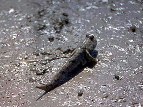
Facultative air-breathing (Ref. 126274); Intertidal, actively shuttling back and forth between rock pools and air (Ref. 31184). They breathe air when out of water (Ref. 31184). Can stay out of the water for up to 22-60 hours if kept moist (Ref. 51276). Inhabits level mudflats with no vegetation (Ref. 92840). Found in estuaries, swamps, marshy areas and tidal mud flats. Moves around briskly on land preying on small animals. Used in Chinese medicine (Ref. 12166).
Cycle de vie et comportement reproducteur
Maturité | Reproduction | Frai | Œufs | Fécondité | Larves
Murdy, E.O., 1989. A taxonomic revision and cladistic analysis of the oxudercine gobies (Gobiidae: Oxudercinae). Rec. Aust. Mus., Suppl. 11:1-93. (Ref. 5218)
Statut dans la liste rouge de l'IUCN (Ref. 130435: Version 2025-2 (Global))
Menace pour l'homme
Harmless
Utilisations par l'homme
Pêcheries: sans intérêt; Aquarium: Commercial
Outils
Articles particuliers
Télécharger en XML
Sources Internet
Estimations basées sur des modèles
Température préférée (Réf.
123201): 16.3 - 26.7, mean 22 °C (based on 280 cells).
Indice de diversité phylogénétique (Réf.
82804): PD
50 = 0.5000 [Uniqueness, from 0.5 = low to 2.0 = high].
Bayesian length-weight: a=0.00851 (0.00550 - 0.01317), b=2.98 (2.85 - 3.11), in cm total length, based on LWR estimates for this species & (Sub)family-body (Ref.
93245).
Niveau trophique (Réf.
69278): 3.3 ±0.4 se; based on size and trophs of closest relatives
Résilience (Réf.
120179): Haut, temps minimum de doublement de population inférieur à 15 mois (Preliminary K or Fecundity.).
Vulnérabilité de la pêche (Ref.
59153): Low vulnerability (10 of 100).
🛈