Cynoglossus bilineatus, Fourlined tonguesole : fisheries, gamefish

You can sponsor this page

Cynoglossus bilineatus (Lacepède, 1802)

Fourlined tonguesole
Beobachtung melden im Fish Watcher
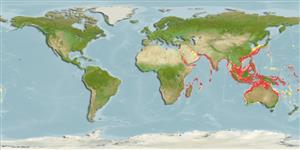
Native range
This map was computer-generated and has not yet been reviewed.
Cynoglossus bilineatus   AquaMaps   Data sources: GBIF OBIS
Hochladen Photos und videos
Bilder | Google Bild
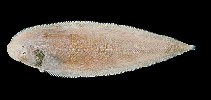
Image of Cynoglossus bilineatus (Fourlined tonguesole)
Cynoglossus bilineatus
Photo von Randall, J.E.

Klassifizierung / Names Namen | Synonyme | Catalog of Fishes(Gattung, Arten) | ITIS | CoL | WoRMS | Cloffa

> Pleuronectiformes (Flatfishes) > Cynoglossidae (Tonguefishes) > Cynoglossinae
Etymology: Cynoglossus: Greek, kyon = dog + Greek, odous = teeth + Greek, glossa = tongue (Ref. 45335).
More on author: Lacepède.

Umwelt: Milieu / Klimazone / Tiefenbereich / Verbreitungsgebiet Ökologie

seewasser; brackwasser demersal; tiefenbereich 10 - 400 m (Ref. 11441). Tropical; 26°C - 29°C (Ref. 4959)

Verbreitung Territorien | FAO Gebiete | Ökosysteme | Vorkommen | Punkt Karte | Einführungen | Faunafri

Indo-West Pacific: Persian Gulf (Ref. 11441), off Pakistan, the west coast of India and Sri Lanka, Indonesia, the Philippines, Japan, and the north and east coasts of Australia.

Größe / Gewicht / Alter

Geschlechtsreife: Lm ?  range ? - ? cm
Max length : 44.0 cm SL Männchen/unbestimmt; (Ref. 559); common length : 30.0 cm TL Männchen/unbestimmt; (Ref. 2872); max. veröff. Gewicht: 61.90 g (Ref. 124479)

Kurzbeschreibung Bestimmungsschlüssel | Morphologie | Morphometrie

Rückenflossenstacheln (insgesamt) : 0; Rückenflossenweichstrahlen (insgesamt) : 107 - 113; Afterflossenstacheln: 0; Afterflossenweichstrahlen: 80 - 88. Eyed side brown with an irregular dark blotch on gill cover, blind side white. Blind side with 2 lateral lines (dorsal and medial). Body elongate, its depth 22 to 29% SL. Eyes with a small scaly interorbital space. Snout rounded. Rostral hook short. Corner of mouth reaching posteriorly beyond lower eye, nearer to gill opening than to tip of snout. Caudal-fin rays usually 12. Midlateral-line scales 88 to 96. Scales ctenoid on eyed side of body. Cycloid on blind side. Scale rows between lateral lines on eyed side of body 13 to 16 (Ref 9895).
Body shape (shape guide): elongated.

Biologie     Fachlexikon (Englisch) (z.B. epibenthic)

Occurs in coastal areas and estuaries. May ascend upstream into the freshwater tidal zone of the Mekong (Ref. 12693). Inhabits muddy and sandy bottoms of continental shelves. Feeds mainly on benthic invertebrates (Ref. 3391). Utilized as a food fish (Ref. 3391). Marketed fresh in the Mekong delta (Ref. 12693).

Lebenszyklus und Paarungsverhalten Geschlechtsreife | Fortpflanzung | Ablaichen | Eier | Fruchtbarkeit | Larven

Hauptreferenz Laden Sie Ihre Referenzen hoch | Referenzen | Koordinator | Partner

Menon, A.G.K., 1977. A systematic monograph of the tongue soles of the genus Cynoglossus Hamilton-Buchanan (Pisces: Cynoglossidae). Smithson. Contrib. Zool. (238):1-129. (Ref. 5297)

IUCN Rote Liste Status (Ref. 130435: Version 2025-2 (Global))

  nicht bedroht (LC) ; Date assessed: 14 August 2019

CITES

Not Evaluated

CMS (Ref. 116361)

Not Evaluated

Bedrohung für Menschen

  Harmless


Nutzung durch Menschen

Fischereien: kommerziell; Sportfisch: ja
FAO - Publication: search | FishSource |

Mehr Information

Trophische Ökologie
Lebensmittel (Beutetiere)
Nahrungszusammensetzung
Nahrungsaufnahme
Lebensmittelrationen
Räuber
Ökologie
Ökologie
Populationsdynamik
Wachstumsparameter
Max. Alter/Größen
Länge-Gewicht-Rel.
Länge-Länge-Verhältnis.
Längenhäufigkeiten
Massenkonvertierung
Rekrutierung
Dichte
Lebenszyklus
Fortpflanzung
Geschlechtsreife
Reifung/Kiemen rel.
Fruchtbarkeit
Ablaichen
Laichaggregationen
Eier
Eientwicklung
Larven
Larven Pop.Dyn.
Verbreitung
Territorien
FAO Gebiete
Ökosysteme
Vorkommen
Einführungen
BRUVS - Videos
Anatomie
Kiemenoberfläche
Gehirn
Otolith
Physiologie
Körperliche Zusammensetzung
Nährstoffe
Sauerstoffverbrauch
Schwimmart
Schwimmgeschwindigkeit
Visuelle Pigmente
Fischgeräusche
Krankheiten und Parasiten
Toxizität (LC50s)
Genetik
Genom
Genetik
Heterozygotie
Vererbbarkeit
Genetische Vielfalt
Menschenbezogen
Aquakultur-Systeme
Aquakultur Profile
Zuchtlinien
Ciguatera-Fälle
Briefmarken, Münzen, Verschiedenes.
Aufsuchen
Partner
Referenzen
Referenzen

Tools

Zusatzinformationen

Download XML

Internet Quellen

AFORO (otoliths) | Aquatic Commons | BHL | Cloffa | Websites from users | FishWatcher Einträge suchen | CISTI | Catalog of Fishes: Gattung, Arten | DiscoverLife | ECOTOX | FAO - Publication: search | Faunafri | Fishipedia | Fishtrace | GloBI | Google Books | Google Scholar | Google | IGFA World Record | Nationale Datenbanken | OneZoom | Open Tree of Life | Otolith Atlas of Taiwan Fishes | PubMed | Reef Life Survey | Socotra Atlas | TreeBase | Tree of Life | Wikipedia: Gehe zu, Suchen | World Records Freshwater Fishing | Zoologischer Rekord

Schätzungen auf der Grundlage von Modellen

Bevorzugte Temperatur (Ref. 123201): 16.9 - 28, mean 23.8 °C (based on 942 cells).
Phylogenetischer Diversitätsindex (Ref. 82804):  PD50 = 0.5000   [Uniqueness, from 0.5 = low to 2.0 = high].
Bayesian length-weight: a=0.00363 (0.00246 - 0.00535), b=3.12 (3.00 - 3.24), in cm total length, based on LWR estimates for this species & Genus-body shape (Ref. 93245).
Trophische Ebene (Ref. 69278):  3.9   ±0.32 se; based on food items.
Widerstandsfähigkeit (Ref. 120179):  mittel, Verdopplung der Population dauert 1,4 - 4,4 Jahre. (Fec = 2,223-225,557).
Anfälligkeit der Fischerei (Ref. 59153):  Moderate vulnerability (41 of 100). 🛈
Preiskategorie (Ref. 80766):   Very high.
Nährstoffe (Ref. 124155):  Calcium = 118 [54, 211] mg/100g; Iron = 0.887 [0.459, 1.592] mg/100g; Protein = 18.1 [15.8, 20.4] %; Omega3 = 0.161 [0.082, 0.314] g/100g; Selenium = 81 [38, 168] μg/100g; VitaminA = 12.2 [3.6, 41.9] μg/100g; Zinc = 1.03 [0.69, 1.51] mg/100g (wet weight);