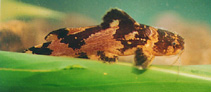
Classification / Noms
Noms communs | Synonymes | Catalog of Fishes(Genre, Espèce) | ITIS | CoL | WoRMS | Cloffa
>
Siluriformes (Catfishes) >
Pseudopimelodidae (Bumblebee catfishes, dwarf marbled catfishes) > Batrochoglaninae
Etymology: Microglanis: Greek, mikros = small + Greek, glanis = a fish that can eat the bait without touching the hook; a cat fish (Ref. 45335).
Eponymy: Cibele Barros Indrusiak has a bachelor’s degree in biology from the Federal University of Rio Grande do Sul (1991) and master’s degree in Wildlife Management awarded by the National University of Córdoba (1997). [...] (Ref. 128868), visit book page.
Environnement : milieu / zone climatique / profondeur / gamme de distribution
Écologie
; eau douce démersal. Temperate
South America: coastal drainages in northern Rio Grande do Sul and Santa Catarina states, Brazil.
Taille / Poids / Âge
Maturité: Lm ? range ? - ? cm
Max length : 7.1 cm SL mâle / non sexé; (Ref. 33009)
Description synthétique
Clés d'identification | Morphologie | Morphométrie
Épines dorsales (Total) : 1; Rayons mous dorsaux (Total) : 6; Rayons mous anaux: 9 - 11; Vertèbres: 30. Microglanis cibelae is the most elongated Microglanis species from southern Brazil. It differs from M. eurystoma and M. cottoides by the smaller head length (25.6-31.1% SL, versus 27.8-36.1 and 29.3-33.8 respectively) and body width (25.4-29.8% SL, versus 30.3-34.7 and 28.5-33.9 respectively). The higher body depth (17.2-22.5% SL) and caudal peduncle depth (10.3-14.3% SL) most clearly distinguish M. cibelae from M. parahybae (12.9-15.6 and 7.6-9.7, respectively).
Cycle de vie et comportement reproducteur
Maturité | Reproduction | Frai | Œufs | Fécondité | Larves
Malabarba, L.R. and J.K.F. Mahler Jr., 1998. Review of the genus Microglanis in the rio Uruguay and coastal drainages of southern Brazil (Ostariophysi: Pimelodidae). Ichthyol. Explor. Freshwat. 9(3):243-254. (Ref. 33009)
Statut dans la liste rouge de l'IUCN (Ref. 130435: Version 2025-2 (Global))
Menace pour l'homme
Harmless
Utilisations par l'homme
Outils
Articles particuliers
Télécharger en XML
Sources Internet
Estimations basées sur des modèles
Indice de diversité phylogénétique (Réf.
82804): PD
50 = 0.5000 [Uniqueness, from 0.5 = low to 2.0 = high].
Bayesian length-weight: a=0.00692 (0.00292 - 0.01638), b=3.12 (2.91 - 3.33), in cm total length, based on LWR estimates for this (Sub)family-body shape (Ref.
93245).
Niveau trophique (Réf.
69278): 3.5 ±0.5 se; based on size and trophs of closest relatives
Vulnérabilité de la pêche (Ref.
59153): Low vulnerability (10 of 100).
🛈