Klassifizierung / Names
Namen | Synonyme | Catalog of Fishes(Gattung, Arten) | ITIS | CoL | WoRMS | Cloffa
Umwelt: Milieu / Klimazone / Tiefenbereich / Verbreitungsgebiet
Ökologie
seewasser demersal. Tropical
Eastern Central Pacific: Bahía de La Paz, southern Baja California, Mexico. Possibly young of some other species (Ref. 35766).
Größe / Gewicht / Alter
Geschlechtsreife: Lm ? range ? - ? cm
Max length : 34.0 cm Männchen/unbestimmt; (Ref. 6902)
Kurzbeschreibung
Bestimmungsschlüssel | Morphologie | Morphometrie
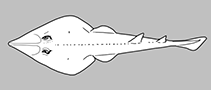
Snout white. Mouth nearly straight. Rostral ridges confluent, very narrow, with a small and short groove at base and with spines. Entire upper surface rough (Ref. 6902).
Body shape (shape guide): elongated.
Ovoviviparous (Ref. 50449). Size is based on original stuffed specimen, now in British Museum (Ref. 6902).
Lebenszyklus und Paarungsverhalten
Geschlechtsreife | Fortpflanzung | Ablaichen | Eier | Fruchtbarkeit | Larven
Exhibit ovoviparity (aplacental viviparity), with embryos feeding initially on yolk, then receiving additional nourishment from the mother by indirect absorption of uterine fluid enriched with mucus, fat or protein through specialised structures (Ref. 50449).
Castro-Aguirre, J.L. and H. Espinosa Perez, 1996. Listados faunísticos de México. VII. Catálogo sistemático de las rayas y especies afines de México. (Chondrichthyes: Elasmobranchii: Rajiformes: Batoideiomorpha). Universidad Nacional Autonoma de Mexico, Mexico. 75 p. (Ref. 28767)
IUCN Rote Liste Status (Ref. 130435: Version 2025-2 (Global))
Bedrohung für Menschen
Harmless
Nutzung durch Menschen
Tools
Zusatzinformationen
Download XML
Internet Quellen
Schätzungen auf der Grundlage von Modellen
Phylogenetischer Diversitätsindex (Ref.
82804): PD
50 = 0.5020 [Uniqueness, from 0.5 = low to 2.0 = high].
Bayesian length-weight: a=0.00347 (0.00143 - 0.00840), b=3.10 (2.89 - 3.31), in cm total length, based on LWR estimates for this (Sub)family-body shape (Ref.
93245).
Trophische Ebene (Ref.
69278): 3.6 ±0.5 se; based on size and trophs of closest relatives
Widerstandsfähigkeit (Ref.
120179): niedrig, Verdopplung der Population dauert 4,5 - 14 Jahre. (Fec assumed to be <100).
Anfälligkeit der Fischerei (Ref.
59153): Very high vulnerability (90 of 100).
🛈