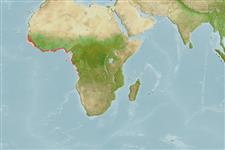
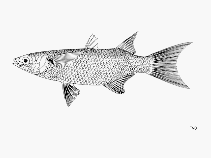
Umwelt: Milieu / Klimazone / Tiefenbereich / Verbreitungsgebiet
Ökologie
seewasser; süßwasser; brackwasser demersal; katadrom (Ref. 138280); tiefenbereich 0 - 25 m (Ref. 121789). Tropical; 21°N - 20°S, 18°W - 16°E
Länge bei der ersten Reifung / Größe / Gewicht / Alter
Geschlechtsreife: Lm 17.8 range ? - ? cm
Max length : 41.0 cm FL Männchen/unbestimmt; (Ref. 57400); common length : 27.0 cm SL Männchen/unbestimmt; (Ref. 7399); max. veröff. Gewicht: 262.00 g (Ref. 55664)
Afterflossenstacheln: 3; Afterflossenweichstrahlen: 10 - 12. Diagnosis: anal fin with at least 13 (usually 14) rays in total (usually III-11 in adults)(Ref. 81659), 10-11 anal soft rays (Ref. 57400). Scales on flanks cycloid; posterior end of maxilla weakly curved or almost straight; serrate, anteroventral edge of lachrymal weakly concave (Ref. 81659). 12-15 scales in an oblique, transverse series; colour of fins greyish-white; second dorsal, pectoral fins and anal fin distinctly falcate (Ref. 57400).
Body shape (shape guide): fusiform / normal.
Euryhaline, tolerating conditions varying from hypersaline to freshwater; favours sandy or muddy substrates (Ref. 81659). Very common in coastal lagoons and estuaries (Ref. 2683, 57400, 81659). Also caught in hypersaline environments (Ref. 57400) and freshwaters (Ref. 7399, 57400, 81659) several kilometres upstream in rivers (Ref. 81659). Adults feed on plankton and detritus (Ref. 28587). Oviparous, eggs are pelagic and non-adhesive (Ref. 205). Spawning may occur in lagoons or in the sea (Ref. 81659). Possibly reaches up to 500mm FL (Ref. 57400, 81659).
Lebenszyklus und Paarungsverhalten
Geschlechtsreife | Fortpflanzung | Ablaichen | Eier | Fruchtbarkeit | Larven
Thomson, J.M., 1990. Mugilidae. p. 855-859. In J.C. Quero, J.C. Hureau, C. Karrer, A. Post and L. Saldanha (eds.) Check-list of the fishes of the eastern tropical Atlantic (CLOFETA). JNICT, Lisbon; SEI, Paris; and UNESCO, Paris. Vol. 2. (Ref. 7399)
IUCN Rote Liste Status (Ref. 130435: Version 2025-2 (Global))
Bedrohung für Menschen
Harmless
Nutzung durch Menschen
Fischereien: kommerziell
Tools
Zusatzinformationen
Download XML
Internet Quellen
Schätzungen auf der Grundlage von Modellen
Bevorzugte Temperatur (Ref.
123201): 23.5 - 27.9, mean 26.5 °C (based on 62 cells).
Phylogenetischer Diversitätsindex (Ref.
82804): PD
50 = 1.0000 [Uniqueness, from 0.5 = low to 2.0 = high].
Bayesian length-weight: a=0.01096 (0.00960 - 0.01252), b=2.95 (2.92 - 2.98), in cm total length, based on LWR estimates for this species (Ref.
93245).
Trophische Ebene (Ref.
69278): 2.9 ±0.37 se; based on food items.
Generation time: 2.7 ( na - na) years. Estimated as median ln(3)/K based on 1
growth studies.
Widerstandsfähigkeit (Ref.
120179): mittel, Verdopplung der Population dauert 1,4 - 4,4 Jahre. (K=0.4;).
Anfälligkeit der Fischerei (Ref.
59153): Low to moderate vulnerability (31 of 100).
🛈
Nährstoffe (Ref.
124155): Calcium = 185 [87, 385] mg/100g; Iron = 1.28 [0.62, 2.58] mg/100g; Protein = 18.4 [16.8, 20.0] %; Omega3 = 0.335 [0.171, 0.717] g/100g; Selenium = 48.6 [25.0, 100.6] μg/100g; VitaminA = 16.5 [5.1, 48.3] μg/100g; Zinc = 1.56 [1.10, 2.25] mg/100g (wet weight);