Taxonomic Remarks
Chinese common names from Ref. 31517 should correspond to the different species names seen in the book.
สิ่งแวดล้อม : สิ่งแวดล้อม / เขตภูมิอากาศ / ระดับความลึก / ระยะการกระจายสินค้า
นิเวศวิทยา
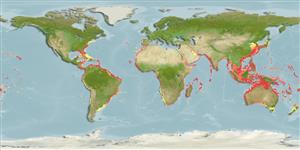
เกี่ยวกับทะเล,น้ำเค็ม; กร่อย เกี่ยวกับหินโสโครก; ระดับความลึก 10 - 219 m (Ref. 9710), usually ? - 40 m (Ref. 5288). Subtropical; 43°N - 50°S, 88°W - 154°W (Ref. 57378)
Western Atlantic: off the coast of New Jersey (USA), Bermuda, Bahamas, Gulf of Mexico and throughout the island groups of the Caribbean to the southernmost coast of Brazil. Eastern Atlantic: off the African coast, from Senegal to Southwest Africa, with a single record from St. Helena. Indo-Pacific: Red Sea and the East African coast to the Society and Hawaiian islands, north to Japan, south to Australia and New Zealand.
Not in Eastern Pacific (Ref. 123477 ver. 09Nov2021).
ขนาด / น้ำหนัก / อายุ
วัยเจริญพันธุ์: Lm ? range ? - ? cm
Max length : 25.0 cm TL เพศผู้/กระเทย; (Ref. 48635); common length : 10.0 cm TL เพศผู้/กระเทย; (Ref. 3585); น้ำหนักสูงสุดที่มีการรายงาน: 32.90 g (Ref. 118626)
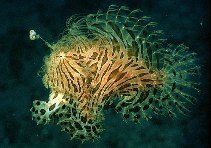
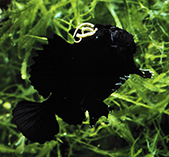
เงี่ยงครีบหลัง (รวม) : 3; ก้านครีบอ่อนที่หาง (รวม) : 11 - 12; เงี่ยงครีบก้น: 0; ก้านครีบอ่อนที่ก้น: 7. Diagnosis: body short and globose; mouth large with many small, villiform teeth; skin rough, covered with bifurcate dermal spinules; pectoral-fin lobes attached to sides of body; illicium at most as long as second dorsal-fin spine; head, body and fins entirely covered with rough, parallel, dark streaks (Ref. 57225).
Body shape (shape guide): short and / or deep; Cross section: compressed.
Inhabit rocky and coral reefs, on rocks, sand or rubble (Ref. 9710). Found in weedy estuaries along the east coast of southern Africa (Ref. 4113). Occurring in marine or brackish waters (Ref. 57225). In the Atlantic, it is found at an average depth of 40 m (Ref. 5288). Benthic (Ref. 58302). Observed to inflate itself greatly like the puffers (Ref. 5521). Oviparous. Males have more intense coloration and extended cutaneous appendages than females (Ref. 205). Eggs are bound in ribbon-like sheath or mass of gelatinous mucus called 'egg raft' or 'veil' (Ref. 6773).
Oviparous. Males have more intense coloration and extended cutaneous appendages than females (Ref. 205). Eggs are bound in ribbon-like sheath or mass of gelatinous mucus called 'egg raft' or 'veil' (Ref. 6773).
Pietsch, T.W. and D.B. Grobecker, 1987. Frogfishes of the world. Systematics, zoogeography, and behavioral ecology. Stanford University Press, Stanford, California. 420 p. (Ref. 6773)
สถานะบัญชีแดงของ IUCN (Ref. 130435: Version 2025-2 (Global))
ภัยคุกคามต่อมนุษย์
Harmless
การใช้ของมนุษย์
การประมง: ไม่มีผลประโยชน์; สถานที่แสดงสัตว์และพืชน้ำ: การค้า
เครื่องมือ
รายงานพิเศษ
ดาวน์โหลด XML
แหล่งที่มาจากอินเตอร์เน็ต
การประมาณค่าตามแบบจำลอง
อุณหภูมิที่ต้องการ (อ้างอิง
123201): 18.2 - 28.6, mean 27 °C (based on 287 cells).
ดัชนีความหลากหลายทางวิวัฒนาการ (อ้างอิง
82804): PD
50 = 0.5002 [Uniqueness, from 0.5 = low to 2.0 = high].
Bayesian length-weight: a=0.02692 (0.01067 - 0.06789), b=2.96 (2.73 - 3.19), in cm total length, based on LWR estimates for this (Sub)family-body shape (Ref.
93245).
ระดับชั้นอาหาร (อ้างอิง
69278): 4.2 ±0.7 se; based on diet studies.
ความสามารถในการกลับคืนสู่ปกติ (อ้างอิง
120179): ความสูง, เวลาต่ำสุดที่จะทำให้ประชากรเพิ่มขึ้นเป็น 2 เท่าใช้เวลาน้อยกว่า 15 เดือน (Fec = 73,000).
ความเสี่ยงต่อการตกปลา (Ref.
59153): Low vulnerability (15 of 100).
🛈
สารอาหาร (Ref.
124155): Calcium = 26.8 [11.8, 72.2] mg/100g; Iron = 0.576 [0.292, 1.139] mg/100g; Protein = 19.7 [17.1, 23.0] %; Omega3 = 0.214 [0.076, 0.560] g/100g; Selenium = 15.7 [6.2, 38.7] μg/100g; VitaminA = 88.5 [18.8, 404.0] μg/100g; Zinc = 0.736 [0.437, 1.191] mg/100g (wet weight);