>
Acropomatiformes (Oceanic basses) >
Epigonidae (Deepwater cardinalfishes)
Etymology: Epigonus: Greek, epi = over, in front + Greek, gonio = angle (Ref. 45335).
Ambiente: milieu / zona climática / intervalo de profundidade / gama de distribuição
Ecologia
marinhas demersal; intervalo de profundidade 230 - 340 m (Ref. 31632). Deep-water
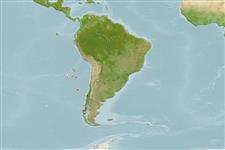
Southeast Pacific: seamount in the Nazca chain. High Seas only.
Tamanho / Peso / Idade
Maturidade: Lm ? range ? - ? cm
Max length : 23.8 cm SL macho/indeterminado; (Ref. 31632)
Descrição breve
Chaves de identificação | Morfologia | Morfometria
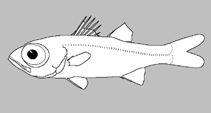
No opercular spines. 8 spines on first dorsal fin. No teeth on tongue. Last spine of the first dorsal fin is considerably removed from the next to last spine and is not joined to it by a membrane (Ref. 31632).
Body shape (shape guide): fusiform / normal.
A mesobenthic-pelagic species living mainly above the bottom (Ref. 31632). No length type given but assumed to be SL.
Ciclo de vida e comportamento de acasalamento
Maturidade | Reprodução | Desova | Ovos | Fecundidade | Larvas
Abramov, A.A., 1992. Species composition and distribution of Epigonus (Epigonidae) in the world ocean. J. Ichthyol. 32(5):94-108. (Ref. 31632)
Categoria na Lista Vermelha da IUCN (Ref. 130435: Version 2025-2 (Global))
Ameaça para o homem
Harmless
Utilização humana
Pescarias: de interesse potencial
Ferramentas
Relatórios especiais
Descarregue XML
Fontes da internet
Estimativas baseadas em modelos
Temperatura preferida (Ref.
123201): 4.4 - 13.3, mean 10.6 °C (based on 40 cells).
Índice de diversidade filogenética (Ref.
82804): PD
50 = 0.5000 [Uniqueness, from 0.5 = low to 2.0 = high].
Bayesian length-weight: a=0.01202 (0.00571 - 0.02532), b=3.02 (2.84 - 3.20), in cm total length, based on LWR estimates for this Genus-body shape (Ref.
93245).
Nível Trófico (Ref.
69278): 3.6 ±0.5 se; based on size and trophs of closest relatives
Resiliência (Ref.
120179): Médio, tempo mínimo de duplicação da população 1,4 - 4,4 anos (Assuming tm=2-4).
Vulnerabilidade da pesca (Ref.
59153): Low vulnerability (19 of 100).
🛈