>
Cyprinodontiformes (Rivulines, killifishes and live bearers) >
Fluviphylacidae (American lampeyes)
Etymology: Fluviphylax: Latin, fluvius = river + Greek,phylax, -akos = guardian (Ref. 45335); palikur: Named for Palikur Indians.
More on authors: Costa & LeBail.
Ambiente: milieu / zona climatica / distribuzione batimetrica / gamma di distribuzione
Ecologia
; acqua dolce benthopelagico. Tropical
South America: Lower Oiapoque (Oyapock) River basin, at the Brazil / French Guiana boarder.
Dimensione / Peso / Età
Maturità: Lm ? range ? - ? cm
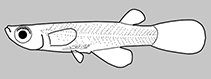
Max length : 2.4 cm TL maschio/sesso non determinato; (Ref. 116983)
Among dense vegetation (Cabomba, Eichornia, Nymphaea) in shallow depths of about 30 cm. Also at the surface during hot periods of the day, where they move around with their pectoral fins only and maintain a bent posture of the posterior body that allows them to dart for cover if they are attacked (Ref. 35237).
Ciclo vitale e comportamento di accoppiamento
Maturità | Riproduzione | Deposizione | Uova | Fecondità | Larve
Costa, W.J.E.M. and P.-Y. Le Bail, 1999. Fluviphylax palikur: a new poeciliid from the Rio Oiapoque Basin, Northern Brazil (Cyprinodontiformes: Cyprinodontoidei), with comments on miniaturization in Fluviphylax and other neotropical freshwater fishes. Copeia 1999(4):1027-1034. (Ref. 33375)
Stato della Lista Rossa IUCN (Ref. 130435: Version 2025-2 (Global))
Minaccia per l'uomo
Harmless
Usi umani
Pesca: di nessun interesse
Strumenti
Rapporti speciali
Scarica XML
Fonti Internet
Stime basate su modelli
Indice di diversità filogenetica (Fonte Biblio.
82804): PD
50 = 0.5078 [Uniqueness, from 0.5 = low to 2.0 = high].
Bayesian length-weight: a=0.00603 (0.00310 - 0.01170), b=3.01 (2.84 - 3.18), in cm total length, based on LWR estimates for this species & (Sub)family-body (Ref.
93245).
Livello trofico (Fonte Biblio.
69278): 3.0 ±0.4 se; based on size and trophs of closest relatives
Vulnerabilità della pesca (Ref.
59153): Low vulnerability (10 of 100).
🛈