>
Eupercaria/misc (Various families in series Eupercaria) >
Labridae (Wrasses) > Hypsigenyinae
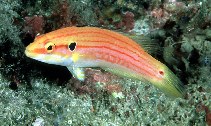
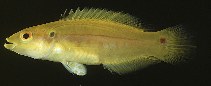
Etymology: Bodianus: Bodianus after Bodiano or Pudiano, from the Portuguese pudor, meaning modesty (Jordan & Evermann, 1896); bimaculatus: Name from Latin 'bis' meaning two or twice and the feminine noun 'macula' for spot, refers to its characteristic black spots on the opercle and caudal peduncle.
Umwelt: Milieu / Klimazone / Tiefenbereich / Verbreitungsgebiet
Ökologie
seewasser riff-verbunden; tiefenbereich 30 - 100 m (Ref. 1602), usually 30 - 60 m (Ref. 27115). Tropical; 22°C - 27°C (Ref. 27115); 31°N - 12°S
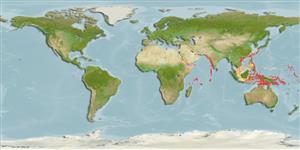
Indo-Pacific: Madagascar to New Caledonia, Japan to New Zealand.
Größe / Gewicht / Alter
Geschlechtsreife: Lm ? range ? - ? cm
Max length : 5.9 cm SL Männchen/unbestimmt; (Ref. 96378)
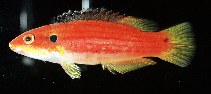
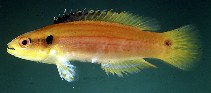
Rückenflossenstacheln (insgesamt) : 12; Rückenflossenweichstrahlen (insgesamt) : 9 - 10; Afterflossenstacheln: 3; Afterflossenweichstrahlen: 11 - 12. Small juveniles are bright yellow and females become more orange as red lines develop. Males are mainly pink with red lines (Ref. 48636).
Body shape (shape guide): fusiform / normal; Cross section: compressed.
Adults are common around rubble and sand in steep outer reef slopes (Ref. 9710), and drop-offs, usually adjacent to very deep water. They form small aggregations in soft bottom habitats with sponges and soft corals. The group usually comprising juveniles and females which are dominated by a large male (Ref. 48636). Oviparous, distinct pairing during breeding (Ref. 205). Maximum depth reported taken from Ref. 128797.
Lebenszyklus und Paarungsverhalten
Geschlechtsreife | Fortpflanzung | Ablaichen | Eier | Fruchtbarkeit | Larven
Oviparous, distinct pairing during breeding (Ref. 205).
Gomon, M.F., 2006. A revision of the labrid fish genus Bodianus with descriptions of eight new species. Rec. Aust. Mus. Suppl. 30:1-133. (Ref. 75973)
IUCN Rote Liste Status (Ref. 130435: Version 2025-2 (Global))
Bedrohung für Menschen
Harmless
Nutzung durch Menschen
Fischereien: kommerziell; Aquarium: Kommerziell
Tools
Zusatzinformationen
Download XML
Internet Quellen
Schätzungen auf der Grundlage von Modellen
Bevorzugte Temperatur (Ref.
123201): 24.6 - 28.3, mean 27.3 °C (based on 154 cells).
Phylogenetischer Diversitätsindex (Ref.
82804): PD
50 = 0.5000 [Uniqueness, from 0.5 = low to 2.0 = high].
Bayesian length-weight: a=0.01047 (0.00493 - 0.02225), b=3.08 (2.90 - 3.26), in cm total length, based on LWR estimates for this Genus-body shape (Ref.
93245).
Trophische Ebene (Ref.
69278): 3.5 ±0.49 se; based on food items.
Widerstandsfähigkeit (Ref.
120179): hoch, Verdopplung der Population dauert weniger als 15 Monate. (Preliminary K or Fecundity.).
Anfälligkeit der Fischerei (Ref.
59153): Low vulnerability (10 of 100).
🛈