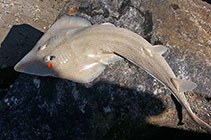
Klassifizierung / Names
Namen | Synonyme | Catalog of Fishes(Gattung, Arten) | ITIS | CoL | WoRMS | Cloffa
Umwelt: Milieu / Klimazone / Tiefenbereich / Verbreitungsgebiet
Ökologie
seewasser; brackwasser demersal; tiefenbereich 75 - ? m (Ref. 114953). Subtropical; 17°S - 36°S, 10°E - 34°E (Ref. 114953)
Southeast Atlantic to West Indian Ocean: Angola to South Africa and southern Mozambique.
Größe / Gewicht / Alter
Geschlechtsreife: Lm ? range ? - ? cm
Max length : 140 cm TL Männchen/unbestimmt; (Ref. 3919)
Found from the surf line to about 70 m depth (Ref. 5578), also reported as common in shallow waters to at least 75 m depth (Ref. 114953); also enters estuaries (Ref. 27121). Feeds on crustaceans, bivalves, polychaete worms and small bony fishes (Ref. 5578). Ovoviviparous (Ref. 50449). Males mature at ca. 59 cm TL, females at 62-65 cm TL; born at ca. 23 cm TL. Produces litters of 2-10 pups (Ref. 114953). Taken by surf anglers (Ref. 3919). Flesh highly esteemed (Ref. 3919). It is parasitised by the monogeneans Pseudoleptobothrium christisoni on the dorsal skin surface (Ref. 124055) and Neoheterocotyle robii on the gill lamellae (Ref. 124054).
Lebenszyklus und Paarungsverhalten
Geschlechtsreife | Fortpflanzung | Ablaichen | Eier | Fruchtbarkeit | Larven
Exhibit ovoviparity (aplacental viviparity), with embryos feeding initially on yolk, then receiving additional nourishment from the mother by indirect absorption of uterine fluid enriched with mucus, fat or protein through specialised structures (Ref. 50449). 2-10 young born in the summer (Ref. 5578).
Compagno, L.J.V., 1986. Rhinobatidae. p. 128-131. In M.M. Smith and P.C. Heemstra (eds.) Smiths' sea fishes. Springer-Verlag, Berlin. (Ref. 3919)
IUCN Rote Liste Status (Ref. 130435: Version 2025-2 (Global))
Bedrohung für Menschen
Harmless
Nutzung durch Menschen
Fischereien: kommerziell; Sportfisch: ja; Aquarium: Kommerziell
Tools
Zusatzinformationen
Download XML
Internet Quellen
Schätzungen auf der Grundlage von Modellen
Bevorzugte Temperatur (Ref.
123201): 16.1 - 25.7, mean 22 °C (based on 36 cells).
Phylogenetischer Diversitätsindex (Ref.
82804): PD
50 = 0.5010 [Uniqueness, from 0.5 = low to 2.0 = high].
Bayesian length-weight: a=0.00214 (0.00123 - 0.00371), b=3.06 (2.90 - 3.22), in cm total length, based on LWR estimates for this species & (Sub)family-body (Ref.
93245).
Trophische Ebene (Ref.
69278): 3.5 ±0.51 se; based on food items.
Widerstandsfähigkeit (Ref.
120179): sehr niedrig, Verdopplung der Population dauert mehr als 14 Jahre. (Fec=2).
Anfälligkeit der Fischerei (Ref.
59153): Very high vulnerability (84 of 100).
🛈