Klassifizierung / Names
Namen | Synonyme | Catalog of Fishes(Gattung, Arten) | ITIS | CoL | WoRMS | Cloffa
Umwelt: Milieu / Klimazone / Tiefenbereich / Verbreitungsgebiet
Ökologie
seewasser demersal; tiefenbereich 0 - 100 m (Ref. 124452), usually ? - 37 m (Ref. 124452). Subtropical; - 32°S
Western Indian Ocean: South Africa, Mozambique, and Tanzania.
Größe / Gewicht / Alter
Geschlechtsreife: Lm ? range ? - ? cm
Max length : 56.5 cm TL Männchen/unbestimmt; (Ref. 124452); 96.0 cm TL (female)
Kurzbeschreibung
Bestimmungsschlüssel | Morphologie | Morphometrie
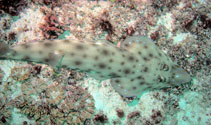
Wirbelzahl: 200 - 205. This medium-sized species is distinguished by the following set of characters: dorsal surface smooth, no prominent thorns or tubercles, except for slightly enlarged granular denticles partially around orbital rims, and rather regularly distributed along midline from nape to near first dorsal-fin origin, none between dorsal fins and upper caudal fin; snout semi-translucent with elongated bluish spots giving stripe-nosed appearance, numerous small bluish spots covering the snout, pectoral, pelvic, dorsal, and caudal fins but not the central disc, on a sandy brown background with darker brown spots of varying sizes covering the disc, tail, fin bases, and fins, and sometimes giving the caudal peduncle a striped appearance, the outer edges of pectoral- and pelvic-fin margins blue, while lateral tail folds white or striped blue and brown and ventral surface white; nasal lamellae 37-41; upper jaw tooth row count ca. 60-75; post-synarcual centra 187-192; total vertebral segments 200-205; total pectoral skeleton radials 63-70 (Ref. 124452).
Cross section: flattened.
Found inshore from the surf line to a depth of 100 m (Ref. 5578, 11228). Feeds on bivalves, gastropods, shrimps, crabs and small bony fishes (Ref. 5578). Common length 92-96 cm TL; males and females mature at about 56 cm TL and birth size ca. 25 cm TL (Ref. 114953). Ovoviviparous (Ref. 50449). Flesh esteemed (Ref. 3919).
Lebenszyklus und Paarungsverhalten
Geschlechtsreife | Fortpflanzung | Ablaichen | Eier | Fruchtbarkeit | Larven
Exhibit ovoviparity (aplacental viviparity), with embryos feeding initially on yolk, then receiving additional nourishment from the mother by indirect absorption of uterine fluid enriched with mucus, fat or protein through specialised structures (Ref. 50449). Bears 2 to 4 young (Ref. 5578).
Weigmann, S., D.A. Ebert, B. Séret, 2021. Resolution of the Acroteriobatus leucospilus species complex, with a redescription of A. leucospilus (Norman, 1926) and descriptions of two new western Indian Ocean species of Acroteriobatus (Rhinopristiformes, Rhinobatidae). Marine Biodiversity (2021):51:58. (Ref. 124452)
IUCN Rote Liste Status (Ref. 130435: Version 2025-2 (Global))
Bedrohung für Menschen
Harmless
Nutzung durch Menschen
Fischereien: kleinfischerei; Sportfisch: ja
Tools
Zusatzinformationen
Download XML
Internet Quellen
Schätzungen auf der Grundlage von Modellen
Phylogenetischer Diversitätsindex (Ref.
82804): PD
50 = 0.5010 [Uniqueness, from 0.5 = low to 2.0 = high].
Bayesian length-weight: a=0.00309 (0.00169 - 0.00566), b=3.10 (2.94 - 3.26), in cm total length, based on LWR estimates for this species & (Sub)family-body (Ref.
93245).
Trophische Ebene (Ref.
69278): 3.7 ±0.60 se; based on food items.
Widerstandsfähigkeit (Ref.
120179): sehr niedrig, Verdopplung der Population dauert mehr als 14 Jahre. (Fec=2).
Anfälligkeit der Fischerei (Ref.
59153): High vulnerability (58 of 100).
🛈