Entorno: milieu / zona climática / rango de profundidad / gama de distribución
Ecología
marino demersal; rango de profundidad 183 - 400 m (Ref. 7460). Tropical
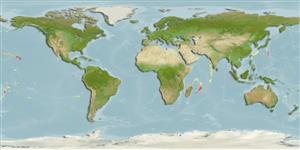
Pacific: Hawaiian Islands and the Emperor Seamount (based on specimens deposited in the National Science Museum, Tokyo).
Tamaño / Peso / Edad
Madurez: Lm ? range ? - ? cm
Max length : 10.2 cm SL macho / no sexado; (Ref. 31667)
Descripción breve
Claves de identificación | Morfología | Morfometría
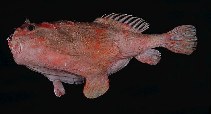
A species belonging to the C. fimbriatus species group which is distinguished mainly from its congeners by its very fine reticulate pattern on the dorsal surface, even in large individuals; with mainly 13 neuromasts in the pectoral series (vs. 12 or less in its congeners) and slightly more numerous neuromasts on the body proper, 33-38 (vs. 29-37) (Ref. 94130).
Benthic (Ref. 58302). A poorly known species which is apparently represented only by a few specimens collected from the Hawaiian Islands and the Emperor Seamount (Ref. 94130).
Ciclo vital y comportamiento de apareamiento
Madurez | Reproducción | Puesta | Huevos | Fecundidad | Larva
Fricke, R., 1999. Fishes of the Mascarene Islands (Réunion, Mauritius, Rodriguez): an annotated checklist, with descriptions of new species. Koeltz Scientific Books, Koenigstein, Theses Zoologicae, Vol. 31:759 p. (Ref. 33390)
Situación en la Lista Roja de la UICN (Ref. 130435: Version 2025-2 (Global))
Amenaza para el ser humano
Harmless
Usos humanos
Herramientas
Informes especiales
Descargar XML
Fuentes de Internet
Estimaciones basadas en modelos
Temperatura preferida (Referencia
123201): 9.9 - 17.1, mean 15.1 °C (based on 5 cells).
Índice de diversidad filogenética (Referencia
82804): PD
50 = 0.5000 [Uniqueness, from 0.5 = low to 2.0 = high].
Bayesian length-weight: a=0.01000 (0.00244 - 0.04107), b=3.04 (2.81 - 3.27), in cm total length, based on all LWR estimates for this body shape (Ref.
93245).
Nivel trófico (Referencia
69278): 3.7 ±0.5 se; based on size and trophs of closest relatives
Resiliencia (Referencia
120179): Bajo, población duplicada en un tiempo mínimo de 4.5-14 años (Assuming tmax>10).
Vulnerabilidad pesquera (Ref.
59153): Low vulnerability (10 of 100).
🛈