>
Eupercaria/misc (Various families in series Eupercaria) >
Sparidae (Porgies)
Etymology: Acanthopagrus: Greek, akantha = thorn + Greek, pagros, a kind of fish (Ref. 45335); berda: Name refers to the local vernacular name for the species; noun in apposition (Ref. 83673).
Umwelt: Milieu / Klimazone / Tiefenbereich / Verbreitungsgebiet
Ökologie
seewasser; süßwasser; brackwasser demersal; ozeanodrom (Ref. 51243); tiefenbereich ? - 50 m (Ref. 86942). Tropical; 30°N - 35°S, 22°E - 103°E
Indian Ocean, South Africa, Mozambique, the Red Sea, Persian Gulf, India, Phuket (Andaman Sea, specimen lost), and Malaysia (Penang Island and Langkawi Island, near Singapore). Western Pacific specimens recorded as A. berda refer to Acanthopagrus pacificus (Ref. 86288).
Länge bei der ersten Reifung / Größe / Gewicht / Alter
Geschlechtsreife: Lm 21.0, range 20 - 22 cm
Max length : 90.0 cm TL Männchen/unbestimmt; (Ref. 3198); common length : 35.0 cm TL Männchen/unbestimmt; (Ref. 5450); max. veröff. Gewicht: 3.2 kg (Ref. 3670); max. veröff. Alter: 14 Jahre (Ref. 3627)
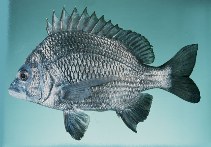
Rückenflossenstacheln (insgesamt) : 11 - 12; Rückenflossenweichstrahlen (insgesamt) : 10 - 13; Afterflossenstacheln: 3; Afterflossenweichstrahlen: 8 - 9. Diagnosis: This species is distinguished from all its congeners by the following characters: scale rows between fifth dorsal-fin spine base and lateral line 3.5; front edge of dorsal scaly area on head slightly convex, with small scales (fewer than 20) anteriorly; pored lateral-line scales 42-44; second anal-fin spine (2AS) longer than third anal-fin spine (3AS), 2AS/3AS ratio 1.23-1.50 (mean 1.36); strongly curved concavity on ventral edge of first two infraorbitals above rear end of maxilla, particularly obvious in specimens more than 13 cm standard length; scales on preopercle flange absent; anal-fin membrane dark; molariform teeth strongly developed along both jaws, teeth rows strongly curved laterally at rear of lower jaw (Ref. 83673).
Body shape (shape guide): short and / or deep; Cross section: compressed.
Common in estuaries, relatively uncommon in freshwaters (Ref. 52193). It feeds on invertebrates, including worms, mollusks, crustaceans and echinoderms (Ref. 5213), and small fish (Ref. 3670, 52193). Breeds in winter at sea (Ref. 52193). Protandrous hermaphrodite (Ref. 55367). The flesh is excellent; sold fresh in markets. It is parasitised by the monogenean Anoplodiscus australis on the fins and body surface (Ref. 124057).
Size at sex change = 19.1 TL; age at sex change = 1.95 years (Ref. 55367).
Iwatsuki, Y. and P.C. Heemstra, 2010. Taxonomic review of the Western Indian Ocean species of the genus Acanthopagrus Peters, 1855 (Perciformes: Sparidae), with description of a new species from Oman. Copeia 2010(1):123-136. (Ref. 83673)
IUCN Rote Liste Status (Ref. 130435: Version 2025-2 (Global))
Bedrohung für Menschen
Harmless
Nutzung durch Menschen
Fischereien: kommerziell; Sportfisch: ja
Tools
Zusatzinformationen
Download XML
Internet Quellen
Schätzungen auf der Grundlage von Modellen
Bevorzugte Temperatur (Ref.
123201): 21.6 - 29, mean 27.8 °C (based on 856 cells).
Phylogenetischer Diversitätsindex (Ref.
82804): PD
50 = 0.5000 [Uniqueness, from 0.5 = low to 2.0 = high].
Bayesian length-weight: a=0.01820 (0.01336 - 0.02478), b=2.97 (2.92 - 3.02), in cm total length, based on LWR estimates for this species (Ref.
93245).
Trophische Ebene (Ref.
69278): 3.5 ±0.42 se; based on food items.
Widerstandsfähigkeit (Ref.
120179): mittel, Verdopplung der Population dauert 1,4 - 4,4 Jahre. (K=0.28-0.38; tmax=14; tm=1).
Anfälligkeit der Fischerei (Ref.
59153): High vulnerability (56 of 100).
🛈
Klimaanfälligkeit (Ref.
125649): High to very high vulnerability (68 of 100).
🛈
Nährstoffe (Ref.
124155): Calcium = 91.7 [45.9, 162.8] mg/100g; Iron = 0.944 [0.530, 1.870] mg/100g; Protein = 19 [18, 20] %; Omega3 = 0.179 [0.101, 0.330] g/100g; Selenium = 59.7 [27.6, 120.1] μg/100g; VitaminA = 7.6 [2.3, 22.6] μg/100g; Zinc = 0.918 [0.599, 1.351] mg/100g (wet weight);