Klassifizierung / Names
Namen | Synonyme | Catalog of Fishes(Gattung, Arten) | ITIS | CoL | WoRMS | Cloffa
>
Clupeiformes (Herrings) >
Engraulidae (Anchovies) > Engraulinae
Etymology: Amazonsprattus: Composed from river Amazon + old English sprot, a small sea fish; 1597 (Ref. 45335).
More on author: Roberts.
Umwelt: Milieu / Klimazone / Tiefenbereich / Verbreitungsgebiet
Ökologie
; süßwasser pelagisch. Tropical; 0°S - 3°S
South America: endemic to the Amazon system (Rio Jufari between Castanheiro Grande and Santa Fé, also Rio Negro at Santa Isabel).
Größe / Gewicht / Alter
Geschlechtsreife: Lm ? range ? - ? cm
Max length : 2.0 cm SL Männchen/unbestimmt; (Ref. 189)
Kurzbeschreibung
Bestimmungsschlüssel | Morphologie | Morphometrie
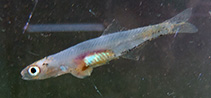
Rückenflossenstacheln (insgesamt) : 0; Afterflossenstacheln: 0; Afterflossenweichstrahlen: 12 - 14. Mouth small, pre-maxillae absent or minute and toothless; maxilla very short, just reaching to front border of eye, with two supra-maxillae; articulation of lower jaw under hind border of pupil or just behind. Dorsal fin origin well behind midpoint of body; anal fin origin under first quarter of dorsal fin base. In life translucent or even transparent.
Body shape (shape guide): elongated; Cross section: compressed.
A riverine species collected some distance up a low-gradient swampy tributary of the Rio Negro (the Rio Jufari), Brazil and in the main river, in both cases the water generally darkly tinted, acid (pH 4-5) and low in dissolved ions. Feeds on dipteran larvae and pupae; also cladocerans. Males mature at 1.43-1.62 cm SL; females at 1.59-1.82 cm. Ovarian eggs are creamy or pale orange. A female of 1.73 cm had 20 eggs in the single ovary in January.
Lebenszyklus und Paarungsverhalten
Geschlechtsreife | Fortpflanzung | Ablaichen | Eier | Fruchtbarkeit | Larven
A female of 1.73 cm has 20 eggs in the single ovary in January.
Whitehead, P.J.P., G.J. Nelson and T. Wongratana, 1988. FAO Species Catalogue. Vol. 7. Clupeoid fishes of the world (Suborder Clupeoidei). An annotated and illustrated catalogue of the herrings, sardines, pilchards, sprats, shads, anchovies and wolf-herrings. FAO Fish. Synop. 125(7/2):305-579. Rome: FAO. (Ref. 189)
IUCN Rote Liste Status (Ref. 130435: Version 2025-2 (Global))
Bedrohung für Menschen
Harmless
Nutzung durch Menschen
Fischereien: nicht kommerziell
Tools
Zusatzinformationen
Download XML
Internet Quellen
Schätzungen auf der Grundlage von Modellen
Phylogenetischer Diversitätsindex (Ref.
82804): PD
50 = 1.0000 [Uniqueness, from 0.5 = low to 2.0 = high].
Bayesian length-weight: a=0.00525 (0.00247 - 0.01115), b=3.14 (2.97 - 3.31), in cm total length, based on LWR estimates for this (Sub)family-body shape (Ref.
93245).
Trophische Ebene (Ref.
69278): 3.2 ±0.35 se; based on food items.
Widerstandsfähigkeit (Ref.
120179): hoch, Verdopplung der Population dauert weniger als 15 Monate. (Preliminary K or Fecundity.).
Anfälligkeit der Fischerei (Ref.
59153): Low vulnerability (10 of 100).
🛈