>
Eupercaria/misc (Various families in series Eupercaria) >
Labridae (Wrasses) > Scarinae
Etymology: Scarus: Greek, skaros = a fish described by anciente writers as a parrot fish; 1601 (Ref. 45335).
More on author: Forsskål.
Environnement : milieu / zone climatique / profondeur / gamme de distribution
Écologie
marin récifal; profondeur 0 - 30 m (Ref. 128797). Tropical; 30°N - 27°S
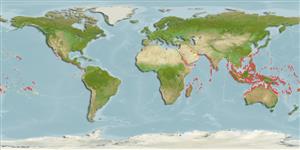
Indo-Pacific: Red Sea south to Sodwana Bay, South Africa (Ref. 5490) and east to the Society Islands, north to the Ryukyu Islands, south to Shark Bay, Western Australia and the southern Great Barrier Reef.
Taille / Poids / Âge
Maturité: Lm ? range ? - ? cm
Max length : 44.4 cm TL mâle / non sexé; (Ref. 125599); poids max. publié: 2.0 kg (Ref. 125599)
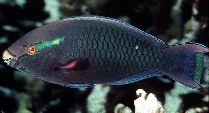
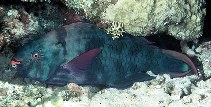
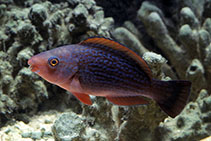
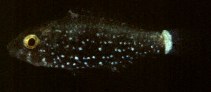
Épines dorsales (Total) : 9; Rayons mous dorsaux (Total) : 10; Épines anales: 3; Rayons mous anaux: 9. This species is distinguished by the following characters: median predorsal scales 6-8 (usually 7); 3 scale rows on cheek, 1(6-7), 2(6-9), 3(2-5); pectoral-fin rays 13-15 (usually 14); conical teeth on side, none in female, usually 2 on upper dental plate for terminal male; lips mainly covering dental plates; caudal fin rounded in small female, with prolonged lobes in large adult. Colour of male reddish brown anteriorly with red upper lip and dark bands around the mouth, greenish posteriorly with dark scale margins, the markings in the head variable but always with a dark-edged yellowish or bright green dot or spot at top end of line from mouth through eye to top of opercular opening.; female red on head, belly and fins, side with wavy black and white stripes, and dark green bands around mouth and eye (Ref. 9793, 90102).
Body shape (shape guide): fusiform / normal; Cross section: compressed.
Inhabits coral-rich areas of clear lagoons, channels, and outer reef slopes (Ref. 9710). Generally solitary (Ref. 1602). Juveniles in small groups on algae and coral reefs inshore (Ref. 48636). Feeds on benthic algae (Ref. 30573). Males maintain small harems and pair spawn (Ref. 1602).
Cycle de vie et comportement reproducteur
Maturité | Reproduction | Frai | Œufs | Fécondité | Larves
Oviparous, distinct pairing during breeding (Ref. 205).
Randall, J.E., G.R. Allen and R.C. Steene, 1990. Fishes of the Great Barrier Reef and Coral Sea. University of Hawaii Press, Honolulu, Hawaii. 506 p. (Ref. 2334)
Statut dans la liste rouge de l'IUCN (Ref. 130435: Version 2025-2 (Global))
Menace pour l'homme
Harmless
Utilisations par l'homme
Pêcheries: commercial; Aquarium: Commercial
Outils
Articles particuliers
Télécharger en XML
Sources Internet
Estimations basées sur des modèles
Température préférée (Réf.
123201): 24.9 - 29.3, mean 28.3 °C (based on 3475 cells).
Indice de diversité phylogénétique (Réf.
82804): PD
50 = 0.5000 [Uniqueness, from 0.5 = low to 2.0 = high].
Bayesian length-weight: a=0.01549 (0.01278 - 0.01877), b=3.05 (3.02 - 3.08), in cm total length, based on LWR estimates for this species (Ref.
93245).
Niveau trophique (Réf.
69278): 2.0 ±0.0 se; based on diet studies.
Résilience (Réf.
120179): Haut, temps minimum de doublement de population inférieur à 15 mois (K=0.37-0.72).
Vulnérabilité de la pêche (Ref.
59153): Low vulnerability (23 of 100).
🛈
Nutriments (Ref.
124155): Calcium = 44.9 [29.2, 75.5] mg/100g; Iron = 0.832 [0.586, 1.273] mg/100g; Protein = 18.7 [16.6, 20.5] %; Omega3 = 0.0871 [, ] g/100g; Selenium = 19.2 [12.1, 30.0] μg/100g; VitaminA = 40.2 [12.3, 137.2] μg/100g; Zinc = 2.26 [1.71, 2.95] mg/100g (wet weight); based on
nutrient studies.