>
Acanthuriformes (Surgeonfishes) >
Chaetodontidae (Butterflyfishes)
Etymology: Chaetodon: Greek, chaite = hair + Greek, odous = teeth (Ref. 45335).
Eponymy: Sir Thomas Stamford Bingley Raffles (1781–1826) was a colonial officer, Lieutenant-Governor of Java (1811–1815) and founder of the city-state of Singapore (1819). [...] (Ref. 128868), visit book page.
Ambiente: milieu / zona climática / intervalo de profundidade / gama de distribuição
Ecologia
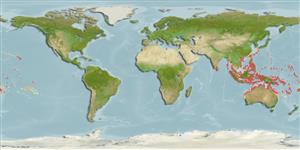
marinhas; estuarina associadas(os) a recifes; intervalo de profundidade 0 - 15 m (Ref. 1602). Tropical; 32°N - 31°S, 77°E - 130°W
Indo-Pacific: Sri Lanka to the Tuamoto Islands, north to southern Japan, south to the Great Barrier Reef; Palau (Belau) to the eastern Caroline Islands in Micronesia.
Tamanho / Peso / Idade
Maturidade: Lm ? range ? - ? cm
Max length : 18.0 cm TL macho/indeterminado; (Ref. 48636); common length : 15.0 cm TL macho/indeterminado; (Ref. 48636)
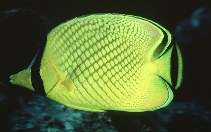
Espinhos dorsais (total) : 12 - 13; Raios dorsais moles (total) : 21 - 23; Espinhos anais: 3; Raios anais moles: 18 - 20. Body color is yellow with cross-hatched pattern on the sides. A dark black spot is sometimes present under the spinous portion of the dorsal fin. A black bar runs across the eye. The dorsal, anal and caudal fins have a dark stripe the position of which varies with age (Ref. 4855). Snout length 2.1-2.6 in HL. Body depth 1.4-1.8 in SL (Ref. 90102).
Body shape (shape guide): short and / or deep; Cross section: compressed.
An uncommon species found in areas of rich coral growth of lagoon and protected reef flats and seaward reefs (Ref. 9710). Often in pairs (Ref. 9710, 48636). Feed on sea anemones, polychaetes, and octocorallian and scleractinian coral polyps. Oviparous (Ref. 205). Form pairs during breeding (Ref. 205). In captivity, this species should be fed algae stones and the so-called 'feeding stones' which are prepared by spreading the food pulp over the stone. Minimum depth reported taken from Ref. 128797.
Ciclo de vida e comportamento de acasalamento
Maturidade | Reprodução | Desova | Ovos | Fecundidade | Larvas
Distinct pairing (Ref. 205).
Myers, R.F., 1991. Micronesian reef fishes. Second Ed. Coral Graphics, Barrigada, Guam. 298 p. (Ref. 1602)
Categoria na Lista Vermelha da IUCN (Ref. 130435: Version 2025-2 (Global))
Ameaça para o homem
Harmless
Utilização humana
Pescarias: pouco comercial; Aquário: Espécies comerciais
Ferramentas
Relatórios especiais
Descarregue XML
Fontes da internet
Estimativas baseadas em modelos
Temperatura preferida (Ref.
123201): 25.1 - 29.3, mean 28.6 °C (based on 2681 cells).
Índice de diversidade filogenética (Ref.
82804): PD
50 = 0.5000 [Uniqueness, from 0.5 = low to 2.0 = high].
Bayesian length-weight: a=0.02291 (0.01123 - 0.04674), b=3.00 (2.83 - 3.17), in cm total length, based on LWR estimates for this Genus-body shape (Ref.
93245).
Nível Trófico (Ref.
69278): 4.3 ±0.0 se; based on diet studies.
Resiliência (Ref.
120179): Elevada, tempo mínimo de duplicação da população menor que 15 meses (Preliminary K or Fecundity.).
Vulnerabilidade da pesca (Ref.
59153): Low vulnerability (10 of 100).
🛈
Nutrientes (Ref.
124155): Calcium = 88.7 [43.0, 172.9] mg/100g; Iron = 0.725 [0.395, 1.299] mg/100g; Protein = 19.4 [18.2, 20.5] %; Omega3 = 0.133 [0.075, 0.238] g/100g; Selenium = 24 [12, 50] μg/100g; VitaminA = 58 [15, 228] μg/100g; Zinc = 1.33 [0.84, 2.00] mg/100g (wet weight);