>
Clupeiformes (Herrings) >
Engraulidae (Anchovies) > Engraulinae
Etymology: Encrasicholina: Greek, egkrasicholos, -os, -on = mixed with spleen.
More on author: Fowler.
Environnement : milieu / zone climatique / profondeur / gamme de distribution
Écologie
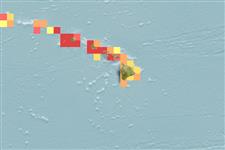
marin; saumâtre pelagic-neritic; profondeur 0 - 50 m (Ref. 189). Tropical; 25°N - 14°N, 165°W - 143°W (Ref. 189)
Eastern Central Pacific: endemic to Hawaii, but its use as a baitfish may spread its range.
Taille / Poids / Âge
Maturité: Lm ? range ? - ? cm
Max length : 7.5 cm SL mâle / non sexé; (Ref. 189)
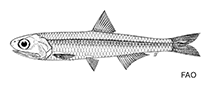
Épines dorsales (Total) : 0; Épines anales: 0; Rayons mous anaux: 13 - 15. Most specimens without pre-pelvic scutes, but some with 1 to 5 thin needle-like scutes. Maxilla tip blunt, reaching to front border of pre-operculum, but scarcely projecting beyond second supra-maxilla. Isthmus short, preceded by a small fleshy plate on urohyal between branchial membranes. Anal fin short, its origin behind base of last dorsal fin ray.
Body shape (shape guide): elongated; Cross section: circular.
Epipelagic (Ref. 58302). A schooling species living close inshore and entering bays, inlets, estuaries, canals and even penetrating into fish ponds, thus able to tolerate a wide range of salinities. Feeds mainly on planktonic crustacean larvae. Breeds throughout the year, with a peak in summer, spawning at night (between 2200 and 0200 hours) in bays and estuaries (Ref. 189).
Cycle de vie et comportement reproducteur
Maturité | Reproduction | Frai | Œufs | Fécondité | Larves
Spawn in bays and estuaries in school (Ref. 205). Spawning is said to be continuous throughout the season (Ref. 32412, 40290).
Whitehead, P.J.P., G.J. Nelson and T. Wongratana, 1988. FAO Species Catalogue. Vol. 7. Clupeoid fishes of the world (Suborder Clupeoidei). An annotated and illustrated catalogue of the herrings, sardines, pilchards, sprats, shads, anchovies and wolf-herrings. FAO Fish. Synop. 125(7/2):305-579. Rome: FAO. (Ref. 189)
Statut dans la liste rouge de l'IUCN (Ref. 130435: Version 2025-2 (Global))
Menace pour l'homme
Harmless
Utilisations par l'homme
Pêcheries: intérêt commercial mineur; appât: usually
Outils
Articles particuliers
Télécharger en XML
Sources Internet
Estimations basées sur des modèles
Température préférée (Réf.
123201): 25 - 25.6, mean 25.3 °C (based on 32 cells).
Indice de diversité phylogénétique (Réf.
82804): PD
50 = 0.5005 [Uniqueness, from 0.5 = low to 2.0 = high].
Bayesian length-weight: a=0.00933 (0.00514 - 0.01693), b=3.20 (3.04 - 3.36), in cm total length, based on LWR estimates for this species & (Sub)family-body (Ref.
93245).
Niveau trophique (Réf.
69278): 3.1 ±0.30 se; based on food items.
Résilience (Réf.
120179): Haut, temps minimum de doublement de population inférieur à 15 mois (K=1.7).
Vulnérabilité de la pêche (Ref.
59153): Low vulnerability (10 of 100).
🛈