Ambiente: milieu / zona climatica / distribuzione batimetrica / gamma di distribuzione
Ecologia
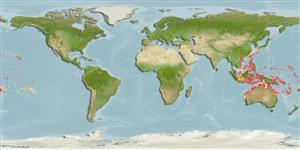
marino associati a barriera corallina; distribuzione batimetrica 0 - 30 m (Ref. 128797). Tropical; 35°N - 29°S, 105°E - 137°W
Pacific Ocean: Indonesia to the Society Islands, north to southern Japan, south to Rowley Shoals and New Caledonia; throughout Micronesia. Reported from Christmas Island in the eastern Indian Ocean (Ref. 5439). Replaced by Heniochus pleurotaenia in the Indian Ocean (Ref. 37816).
Dimensione / Peso / Età
Maturità: Lm ? range ? - ? cm
Max length : 19.0 cm TL maschio/sesso non determinato; (Ref. 9710)
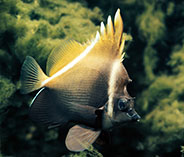
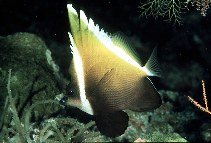
Spine dorsali (totale) : 11; Raggi dorsali molli (totale) : 22 - 25; Spine anali: 3; Raggi anali molli: 17 - 18. This species is distinguished by the following characters: adults with a pair of prominent horns on the forehead, just above the eyes and a distinct protuberance on forehead; snout length 2.9-3.5 in HL; greatest body depth 1.3-1.5 in SL. Colour solid brown to blackish triangular area between white bands (2 white bands running from caudal peduncle and breast to each end of spinous section of dorsal fin) (Ref. 90102).
Body shape (shape guide): short and / or deep; Cross section: compressed.
Occur in deep lagoons and steep outer reef slopes, with mixed algae and coral growth (Ref. 48636). Solitary or in small groups. Feed on corals and other invertebrates (Ref. 9710). Oviparous (Ref. 205). Form pairs during breeding (Ref. 205). Maximum depth reported taken from Ref. 48636.
Ciclo vitale e comportamento di accoppiamento
Maturità | Riproduzione | Deposizione | Uova | Fecondità | Larve
Form pairs during breeding (Ref. 205).
Myers, R.F., 1991. Micronesian reef fishes. Second Ed. Coral Graphics, Barrigada, Guam. 298 p. (Ref. 1602)
Stato della Lista Rossa IUCN (Ref. 130435: Version 2025-2 (Global))
Minaccia per l'uomo
Harmless
Usi umani
Pesca: scarso interesse commerciale; Acquario: Commerciale
Strumenti
Rapporti speciali
Scarica XML
Fonti Internet
Stime basate su modelli
Temperatura preferita (Fonte Biblio.
123201): 25.4 - 29.3, mean 28.5 °C (based on 1964 cells).
Indice di diversità filogenetica (Fonte Biblio.
82804): PD
50 = 0.5039 [Uniqueness, from 0.5 = low to 2.0 = high].
Bayesian length-weight: a=0.02239 (0.01107 - 0.04526), b=3.01 (2.84 - 3.18), in cm total length, based on LWR estimates for this (Sub)family-body shape (Ref.
93245).
Livello trofico (Fonte Biblio.
69278): 3.2 ±0.3 se; based on diet studies.
Resilienza (Fonte Biblio.
120179): Alto, tempo minimo di raddoppiamento della popolazione meno di 15 mesi (Preliminary K or Fecundity.).
Vulnerabilità della pesca (Ref.
59153): Low vulnerability (10 of 100).
🛈
Nutrienti (Ref.
124155): Calcium = 94.2 [49.4, 142.9] mg/100g; Iron = 0.789 [0.472, 1.271] mg/100g; Protein = 18.7 [17.5, 19.7] %; Omega3 = 0.115 [0.072, 0.179] g/100g; Selenium = 31.7 [18.1, 58.9] μg/100g; VitaminA = 47.7 [14.2, 157.0] μg/100g; Zinc = 1.37 [0.94, 1.96] mg/100g (wet weight);