>
Eupercaria/misc (Various families in series Eupercaria) >
Labridae (Wrasses) > Cheilininae
Etymology: Epibulus: Greek, epi = over, in front + Greek, boleo = to throw (Ref. 45335).
More on author: Pallas.
Lingkungan: lingkungan / zona iklim / kisaran kedalaman / jangkauan distribusi
Ekologi
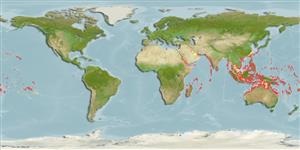
laut berasosiasi dengan karang; kisaran kedalaman 0 - 50 m (Ref. 128797). Tropical; 30°N - 30°S
Indo-Pacific: Red Sea to South Africa (Ref. 35918) and the Hawaiian and Tuamoto islands, north to southern Japan, south to New Caledonia.
Ukuran / Berat / umur
Kematangan: Lm ? range ? - ? cm
Max length : 54.0 cm SL jantan/; (Ref. 9823)
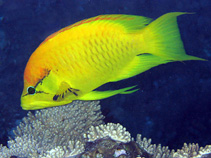
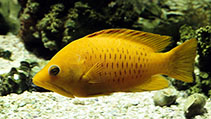
Duri punggung (Keseluruhan (total)) : 9 - 10; duri punggung lunak (Keseluruhan (total)) : 9 - 11; Duri dubur: 3; Sirip dubur lunak: 8 - 9. The mouth of this species is protrusible and unfolds into a tube easily half the body length. The jaws swing forward into a long tube that strong suction to catch prey. When not in use, the entire apparatus is conveniently folded under the head. Small juveniles are brown with thin white bars and closely resemble a species of Wetmorella. Color varies with age and sex, but adult color varies additional, including with an all-yellow xanthic form. Sub adults and females are brown or, not uncommonly, uniformly yellow. Terminal males are dark with a white head and a dark streak extending horizontally through the eye. Male becomes ornamented with orange and yellow over the back. Juveniles dark with fine vertical white lines. Intermediates with yellow blotches, pale tail and sometimes with black pectoral fins (Ref. 48636).
Body shape (shape guide): short and / or deep; Cross section: compressed.
Inhabit coral-rich areas of lagoon and seaward reefs (Ref. 1602, 58302). Benthopelagic (Ref. 58302). Generally solitary (Ref. 5213). Feed on small coral-dwelling crustaceans and fishes (Ref. 9710). Capable of drift migration along with floating leaves (Ref. 27153). Adults usually along deep slopes or drop-offs. Sometimes they visit cleaning stations holding their mouth open and out for inspection (Ref. 48636).
Siklus hidup dan perilaku kawin
Kematangan | Reproduksi, perkembang biakan | Pemijahan | telur-telur | Fekunditas | Larva
Males have been observed patrolling their mating territory (see Ref. 27152). Protogyny was proposed but not confirmed (Ref. 103751).
Randall, J.E., G.R. Allen and R.C. Steene, 1990. Fishes of the Great Barrier Reef and Coral Sea. University of Hawaii Press, Honolulu, Hawaii. 506 p. (Ref. 2334)
Status IUCN Red List (Ref. 130435: Version 2025-2 (Global))
ancaman kepada manusia
Reports of ciguatera poisoning (Ref. 4690)
penggunaan manusia
Perikanan: nilai komersial kecil; Akuarium: Komersial
Alat, peralatan
laporan khas
muat turun XML
Sumber internet
Estimasi berdasarkan model
Suhu yang disukai (Acuan
123201): 24.7 - 29, mean 27.9 °C (based on 790 cells).
Indeks keanekaragaman filogenetik (Acuan
82804): PD
50 = 0.7500 [Uniqueness, from 0.5 = low to 2.0 = high].
Bayesian length-weight: a=0.02188 (0.01206 - 0.03969), b=2.95 (2.79 - 3.11), in cm total length, based on LWR estimates for this species & (Sub)family-body (Ref.
93245).
Tingkat Trofik (Acuan
69278): 4.0 ±0.66 se; based on food items.
Daya lenting (Acuan
120179): Rendah, Waktu penggandaan populasi minimum 4.5 - 14 tahun (Preliminary K or Fecundity.).
Kerentanan Penangkapan Ikan (Ref.
59153): Moderate to high vulnerability (46 of 100).
🛈
Nutrisi (Ref.
124155): Calcium = 36.4 [12.3, 145.1] mg/100g; Iron = 0.515 [0.197, 1.250] mg/100g; Protein = 18.4 [15.4, 20.7] %; Omega3 = 0.133 [0.067, 0.276] g/100g; Selenium = 32.4 [11.6, 84.5] μg/100g; VitaminA = 65.8 [17.4, 310.7] μg/100g; Zinc = 1.95 [0.61, 3.51] mg/100g (wet weight); based on
nutrient studies.