>
Eupercaria/misc (Various families in series Eupercaria) >
Labridae (Wrasses) > Xyrichtyinae
Etymology: Novaculichthys: Latin, novacula = razor + Greek, ichthys = fish (Ref. 45335).
More on author: Lacepède.
البيئة: الوسط / المنطقة المناخية / نطاق العمق / نطاق التوزيع
البيئة
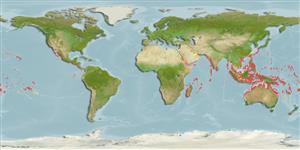
بحري مرتبطة بالشعاب; نطاق العمق 3 - 25 m (Ref. 30573), usually ? - 14 m (Ref. 27115). Tropical; 24°C - 28°C (Ref. 27115); 30°N - 30°S, 32°E - 77°W
Indo-Pacific: Red Sea to South Africa (Ref. 35918) and the Tuamoto Islands, north to Ryukyu and Hawaiian islands, south to Lord Howe Island. Excluding Persian Gulf (Ref. 86689). Eastern Pacific: Gulf of California to Panama and the Galapagos Islands (Ref. 5227).
الحجم / وزن / العمر
النضج: Lm ? range ? - ? cm
Max length : 30.0 cm TL ذكر/ مختلط الجنس; (Ref. 2334)
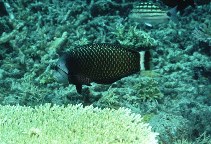
الأشواك الظهرية (المجموع) : 9; الأشعة الظهرية الناعمة (المجموع) : 12 - 13; شوكة شرجية: 3; أشعه شرجية لينه: 12 - 13. Juveniles have long extended dorsal fin spines (Ref. 48636).
Body shape (shape guide): fusiform / normal; Cross section: compressed.
Inhabit semi-exposed reef flats and lagoon and seaward reefs (Ref. 1602). Common in areas of mixed sand, and rubble that are subject to mild surge (Ref. 1602, 58466). Benthopelagic (Ref. 58302). Juveniles shallow on rubble amongst large bommies or protected open patches on reef crests and swim as if were a leaf floating along the bottom; large adults move along over large reef section, usually in pairs and typically turn or shift large pieces of rubble or debris that they grab and pull with their mouth or push over with their snout. Often, while one works the piece, the other grabs exposed prey. They are sometimes called rock-mover wrasse, but they don't move real rocks (Ref. 48636). Highly territorial (Ref. 9823). Feed on mollusks, sea urchins, brittle stars, polychaetes, and crabs (Ref. 5213); feeding is done by overturning large rocks to expose target preys. The young imitate drifting masses of algae (Ref. 2334). Marketed fresh (Ref. 9311). Minimum depth reported from Ref. 30874.
دورة الحياة وسلوك التزاوج
النضج | التكاثر | وضع البيض | بيض | الخصوبة | اليرقات
Oviparous, distinct pairing during breeding (Ref. 205).
Randall, J.E., G.R. Allen and R.C. Steene, 1990. Fishes of the Great Barrier Reef and Coral Sea. University of Hawaii Press, Honolulu, Hawaii. 506 p. (Ref. 2334)
حالة القائمة الحمراء للاتحاد الدولي لحفظ الطبيعة والموارد الطبيعية (Ref. 130435: Version 2025-2 (Global))
استخدامات بشرية
مصائد: غير مهمة تجارياً; حوض مائي: تجاري
أدوات
تقارير خاصة
تنزيل XML
مصادر علي الأنترنت
تقديرات تستند إلى النماذج
درجة الحرارة المفضلة (مرجع
123201): 24.9 - 29.3, mean 28.3 °C (based on 3357 cells).
مؤشر التنوع الشُعبي الوراثي (مرجع
82804): PD
50 = 1.0000 [Uniqueness, from 0.5 = low to 2.0 = high].
Bayesian length-weight: a=0.01479 (0.00748 - 0.02924), b=3.04 (2.86 - 3.22), in cm total length, based on LWR estimates for this species & (Sub)family-body (Ref.
93245).
مستوى غذائي (مرجع
69278): 3.3 ±0.40 se; based on food items.
المرونه (مرجع
120179): وسيط, الحد الزمني الأدني لتضاعف عدد أفراد المجتمع 1.4-4.4 سنة (Preliminary K or Fecundity.).
ضعف الصيد (Ref.
59153): Low vulnerability (20 of 100).
🛈
المغذيات (Ref.
124155): Calcium = 55.7 [34.0, 89.0] mg/100g; Iron = 0.601 [0.357, 1.082] mg/100g; Protein = 18.5 [15.7, 20.7] %; Omega3 = 0.133 [0.089, 0.197] g/100g; Selenium = 25.8 [16.4, 44.3] μg/100g; VitaminA = 112 [36, 384] μg/100g; Zinc = 1.48 [1.07, 2.34] mg/100g (wet weight);