>
Eupercaria/misc (Various families in series Eupercaria) >
Labridae (Wrasses) > Julidinae
Etymology: Halichoeres: Greek, als, alis = salt + Greek, choiros = pig (Ref. 45335).
More on author: Valenciennes.
Ambiente: milieu / zona climatica / distribuzione batimetrica / gamma di distribuzione
Ecologia
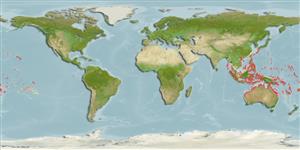
marino associati a barriera corallina; distribuzione batimetrica 0 - 5 m (Ref. 30874). Tropical; 32°N - 32°S, 91°E - 133°W
Indo-Pacific: Cocos Island in the eastern Indian Ocean to the Line and Tuamoto islands, north to southern Japan, south to New South Wales and Lord Howe Island. Replaced by Halichoeres nebulosus in the western Indian Ocean.
Dimensione / Peso / Età
Maturità: Lm ? range ? - ? cm
Max length : 12.5 cm SL maschio/sesso non determinato; (Ref. 9823)
Breve descrizione
Chiavi di identificazione | Morfologia | Morfometria
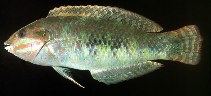
Spine dorsali (totale) : 9; Raggi dorsali molli (totale) : 11; Spine anali: 3; Raggi anali molli: 11. Females olivaceous on back, the scale edges dark brown, pale ventrally, with whitish blotches of unequal size and a large pink area posteriorly on the abdomen; a black spot on opercular flap, small one behind eye, one at front of dorsal fin and a large one rimmed in yellow or blue in middle of fin; no black spot at upper base of pectoral fins; males green with orange-red spots, some linked to form irregular markings, the white blotches and large pink area on abdomen lost, and the black spots lost or reduced. Males are distinguished by different cheek patterns. In this species, it has a near horizontal pink band below the eye (Ref. 48636).
Body shape (shape guide): fusiform / normal; Cross section: compressed.
Inhabits shallow reefs and rocky shores, usually in weedy areas exposed to surge (Ref. 9710, 48636). Feeds on benthic crustaceans, mollusks, polychaetes, forams, fishes, and fish eggs (Ref. 1602). One of several similar species that have near identical juvenile and female stages (Ref. 48636).
Ciclo vitale e comportamento di accoppiamento
Maturità | Riproduzione | Deposizione | Uova | Fecondità | Larve
Distinct pairing during breeding (Ref. 205).
Randall, J.E., G.R. Allen and R.C. Steene, 1990. Fishes of the Great Barrier Reef and Coral Sea. University of Hawaii Press, Honolulu, Hawaii. 506 p. (Ref. 2334)
Stato della Lista Rossa IUCN (Ref. 130435: Version 2025-2 (Global))
Minaccia per l'uomo
Harmless
Usi umani
Pesca: commerciale; Acquario: Commerciale
Strumenti
Rapporti speciali
Scarica XML
Fonti Internet
Stime basate su modelli
Temperatura preferita (Fonte Biblio.
123201): 24.7 - 29.1, mean 28.4 °C (based on 1912 cells).
Indice di diversità filogenetica (Fonte Biblio.
82804): PD
50 = 0.5000 [Uniqueness, from 0.5 = low to 2.0 = high].
Bayesian length-weight: a=0.01000 (0.00475 - 0.02106), b=3.09 (2.92 - 3.26), in cm total length, based on LWR estimates for this Genus-body shape (Ref.
93245).
Livello trofico (Fonte Biblio.
69278): 3.7 ±0.50 se; based on food items.
Resilienza (Fonte Biblio.
120179): Alto, tempo minimo di raddoppiamento della popolazione meno di 15 mesi (Preliminary K or Fecundity.).
Vulnerabilità della pesca (Ref.
59153): Low vulnerability (10 of 100).
🛈
Nutrienti (Ref.
124155): Calcium = 104 [59, 191] mg/100g; Iron = 0.742 [0.405, 1.467] mg/100g; Protein = 18.6 [15.7, 20.8] %; Omega3 = 0.139 [0.080, 0.238] g/100g; Selenium = 14.9 [7.9, 30.9] μg/100g; VitaminA = 181 [50, 712] μg/100g; Zinc = 1.82 [1.18, 2.92] mg/100g (wet weight);