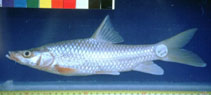
Environnement : milieu / zone climatique / profondeur / gamme de distribution
Écologie
; eau douce benthopélagique. Tropical; 13°N - 11°N
Taille / Poids / Âge
Maturité: Lm ? range ? - ? cm
Max length : 41.0 cm FL mâle / non sexé; (Ref. 35835)
Description synthétique
Clés d'identification | Morphologie | Morphométrie
Épines dorsales (Total) : 0; Rayons mous dorsaux (Total) : 12 - 13; Épines anales: 0; Rayons mous anaux: 8. Snout more than 4 times in head length; interorbital width more than 2 times in head width; head depth more than 2 times in head length; operculum depth more than 3.4 times in head length; silvery white.
Body shape (shape guide): elongated.
Over muddy, sandy and rocky substrates all over Lake Tana, preferably in water deeper than 6 m. Juveniles feed on zooplankton and insect larvae. Adults feed on other fish (Ref. 35835).
Cycle de vie et comportement reproducteur
Maturité | Reproduction | Frai | Œufs | Fécondité | Larves
Nagelkerke, L.A.J. and F.A. Sibbing, 1997. A revision of the large barbs (Barbus spp., Cyprinidae, Teleostei) of Lake Tana, Ethiopia, with a description of seven new species. p. 105-170. In L.A.J. Nagelkerke (ed.) The barbs of Lake Tana, Ethiopia: morphological diversity and its implications for taxonomy, trophic resource partititioning and fisheries. Wageningen University, The Netherlands. (Ref. 35835)
Statut dans la liste rouge de l'IUCN (Ref. 130435: Version 2025-2 (Global))
Menace pour l'homme
Harmless
Utilisations par l'homme
Pêcheries: sans intérêt
Outils
Articles particuliers
Télécharger en XML
Sources Internet
Estimations basées sur des modèles
Indice de diversité phylogénétique (Réf.
82804): PD
50 = 0.5000 [Uniqueness, from 0.5 = low to 2.0 = high].
Bayesian length-weight: a=0.00468 (0.00218 - 0.01003), b=3.10 (2.90 - 3.30), in cm total length, based on LWR estimates for this (Sub)family-body shape (Ref.
93245).
Niveau trophique (Réf.
69278): 3.6 ±0.53 se; based on food items.
Résilience (Réf.
120179): Milieu, temps minimum de doublement de population : 1,4 à 4,4 années (Preliminary K or Fecundity.).
Vulnérabilité de la pêche (Ref.
59153): Moderate vulnerability (36 of 100).
🛈