>
Ophidiiformes (Cusk eels) >
Ophidiidae (Cusk-eels) > Neobythitinae
Etymology: Mastigopterus: Greek, mastax, -agos = bite + Greek, pteron = wing, fin (Ref. 45335).
More on authors: Smith & Radcliffe.
Environnement : milieu / zone climatique / profondeur / gamme de distribution
Écologie
marin bathydémersal; profondeur 394 - 2365 m (Ref. 43943). Deep-water
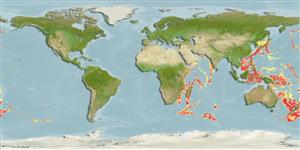
Indo-West Pacific: Madagascar, the East and South China seas and Papua New Guinea.
Taille / Poids / Âge
Maturité: Lm ? range ? - ? cm
Max length : 53.5 cm SL mâle / non sexé; (Ref. 43943)
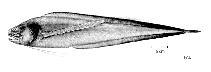
Head large; mouth subterminal. Eye diameter less than snout length. Opercular spine weak, broad, and flattened. Prominent cephalic sensory pores below eyes and on rear margin of preoperculum. Median basibranchial tooth patches 2. Vomer with V-shaped tooth patch. Anterior gill arch with 10-12 long rakers. Pectoral fins 12-15 rays, the longest about 1/2 or more in SL. Pelvic fins with 2 joined rays in each. Caudal fin rays 6. Branchiostegal rays 8. Precaudal vertebrae 15-16. Cycloid scales small, deciduous, covering head, body, and bases of dorsal, anal, and pectoral fins. Lateral line indistinct (Ref. 43943).
Body shape (shape guide): elongated; Cross section: compressed.
A rare species inhabiting the deep-sea floor in the tropical to temperate waters (Ref. 43943). Reproductive strategy possibly similar to other members of this family featuring oviparity, with oval pelagic eggs floating in a gelatinous mass (Ref. 205).
Cycle de vie et comportement reproducteur
Maturité | Reproduction | Frai | Œufs | Fécondité | Larves
Nielsen, J.G., D.M. Cohen, D.F. Markle and C.R. Robins, 1999. Ophidiiform fishes of the world (Order Ophidiiformes). An annotated and illustrated catalogue of pearlfishes, cusk-eels, brotulas and other ophidiiform fishes known to date. FAO Fish. Synop. 125(18):178p. Rome: FAO. (Ref. 34024)
Statut dans la liste rouge de l'IUCN (Ref. 130435: Version 2025-2 (Global))
Menace pour l'homme
Harmless
Utilisations par l'homme
Pêcheries: sans intérêt
Outils
Articles particuliers
Télécharger en XML
Sources Internet
Estimations basées sur des modèles
Température préférée (Réf.
123201): 2.6 - 7.8, mean 4.8 °C (based on 786 cells).
Indice de diversité phylogénétique (Réf.
82804): PD
50 = 1.0000 [Uniqueness, from 0.5 = low to 2.0 = high].
Bayesian length-weight: a=0.00380 (0.00165 - 0.00876), b=3.14 (2.93 - 3.35), in cm total length, based on LWR estimates for this (Sub)family-body shape (Ref.
93245).
Niveau trophique (Réf.
69278): 3.7 ±0.6 se; based on size and trophs of closest relatives
Résilience (Réf.
120179): Milieu, temps minimum de doublement de population : 1,4 à 4,4 années (Preliminary K or Fecundity.).
Vulnérabilité de la pêche (Ref.
59153): Moderate to high vulnerability (46 of 100).
🛈