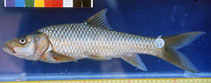
Ambiente: milieu / zona climatica / distribuzione batimetrica / gamma di distribuzione
Ecologia
; acqua dolce benthopelagico; distribuzione batimetrica 1 - 6 m (Ref. 35835). Tropical; 13°N - 11°N
Dimensione / Peso / Età
Maturità: Lm ? range ? - ? cm
Max length : 54.8 cm FL maschio/sesso non determinato; (Ref. 35835)
Breve descrizione
Chiavi di identificazione | Morfologia | Morfometria
Spine dorsali (totale) : 0; Raggi dorsali molli (totale) : 12 - 14; Spine anali: 0; Raggi anali molli: 8. Very slender build: head length longer than body depth; body depth more than 4 times in standard length; ventral fin length more than 1.8 times in head length; eye diameter more than 2 times in snout length, more than 1.8 times in interorbital width; greenish or greenish grey.
Body shape (shape guide): elongated.
Occurs mostly over rocky substrates in relatively shallow water (less than 6 m). It is a real piscivore, with almost 100% of its food consisting of fish (Ref. 35835).
Ciclo vitale e comportamento di accoppiamento
Maturità | Riproduzione | Deposizione | Uova | Fecondità | Larve
Nagelkerke, L.A.J. and F.A. Sibbing, 1997. A revision of the large barbs (Barbus spp., Cyprinidae, Teleostei) of Lake Tana, Ethiopia, with a description of seven new species. p. 105-170. In L.A.J. Nagelkerke (ed.) The barbs of Lake Tana, Ethiopia: morphological diversity and its implications for taxonomy, trophic resource partititioning and fisheries. Wageningen University, The Netherlands. (Ref. 35835)
Stato della Lista Rossa IUCN (Ref. 130435: Version 2025-2 (Global))
Minaccia per l'uomo
Harmless
Usi umani
Pesca: di nessun interesse
Strumenti
Rapporti speciali
Scarica XML
Fonti Internet
Stime basate su modelli
Indice di diversità filogenetica (Fonte Biblio.
82804): PD
50 = 0.5000 [Uniqueness, from 0.5 = low to 2.0 = high].
Bayesian length-weight: a=0.00468 (0.00218 - 0.01003), b=3.10 (2.90 - 3.30), in cm total length, based on LWR estimates for this (Sub)family-body shape (Ref.
93245).
Livello trofico (Fonte Biblio.
69278): 4.5 ±0.80 se; based on food items.
Resilienza (Fonte Biblio.
120179): Basso, tempo minimo di raddoppiamento della popolazione 4.5 - 14 anni (Preliminary K or Fecundity.).
Vulnerabilità della pesca (Ref.
59153): Moderate vulnerability (44 of 100).
🛈