>
Eupercaria/misc (Various families in series Eupercaria) >
Labridae (Wrasses) > Julidinae
Etymology: Thalassoma: Greek, thalassa = the sea + Greek, soma = body; the colour of the sea (Ref. 45335).
More on author: Lacepède.
Entorno: milieu / zona climática / rango de profundidad / gama de distribución
Ecología
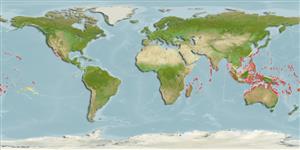
marino asociado a arrecife; rango de profundidad 0 - 10 m (Ref. 1602). Tropical; 30°N - 28°S
Indo-Pacific: East Africa to the Pitcairn, north to the Ryukyu Islands, south to Tonga and Rapa.
Tamaño / Peso / Edad
Madurez: Lm ? range ? - ? cm
Max length : 30.0 cm TL macho / no sexado; (Ref. 4392)
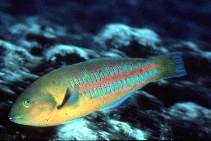
Espinas dorsales (total) : 8; Radios blandos dorsales (total) : 13; Espinas anales: 3; Radios blandos anales: 11. This species is distinguished by the following characters: greatest body depth 2.7-3.6 in SL; pectoral fin rays usually 16; lateral line scales 25; total gill rakers on first gill arch 17-24 (modally 20); caudal fin of initial phase slightly rounded to truncate, of terminal males truncate to slightly double emaginate; Body of initial (female) phase greenish grey to pale green with 5-6 dark saddles on back, pair of dark (sometimes diffused) stripes on side, a dark vertical line on most scales of body, and with a diagonal (or C-shaped) pink to dark red below front of eye; while body of terminal male salmon-pink to orange anteriorly, with 2 longitudinal series of vertical green rectangles, every fourth pair of upper series extending as a single green bar across back, the head orange-brown without bands and caudal fin brownish to greenish, shading distally to pink, the posterior third of rays blue (Ref. 9823, 86689, 90102).
Body shape (shape guide): fusiform / normal; Cross section: compressed.
Found solitary or in groups (Ref. 90102) in shallow exposed reef flats, usually with rock-base and mixed coral and algae (Ref. 48636, 58302). Also occurs in surge-swept reef flats, reef margins, and clear rocky shorelines, but may venture to deeper waters up to 10 m (Ref. 3921). Benthopelagic (Ref. 58302). Feeds on crustaceans (especially crabs), mollusks, and ophiuroids (brittle stars) (Ref. 3921).
Ciclo vital y comportamiento de apareamiento
Madurez | Reproducción | Puesta | Huevos | Fecundidad | Larva
Oviparous, distinct pairing during breeding (Ref. 205).
Randall, J.E., G.R. Allen and R.C. Steene, 1990. Fishes of the Great Barrier Reef and Coral Sea. University of Hawaii Press, Honolulu, Hawaii. 506 p. (Ref. 2334)
Situación en la Lista Roja de la UICN (Ref. 130435: Version 2025-2 (Global))
Amenaza para el ser humano
Harmless
Usos humanos
Pesquerías: escaso valor comercial; Acuario: Comercial
Herramientas
Informes especiales
Descargar XML
Fuentes de Internet
Estimaciones basadas en modelos
Temperatura preferida (Referencia
123201): 24.9 - 29.3, mean 28.3 °C (based on 2665 cells).
Índice de diversidad filogenética (Referencia
82804): PD
50 = 0.5000 [Uniqueness, from 0.5 = low to 2.0 = high].
Bayesian length-weight: a=0.01000 (0.00446 - 0.02243), b=3.05 (2.88 - 3.22), in cm total length, based on LWR estimates for this Genus-body shape (Ref.
93245).
Nivel trófico (Referencia
69278): 3.8 ±0.58 se; based on food items.
Resiliencia (Referencia
120179): Medio, población duplicada en un tiempo mínimo de 1.4-4.4 años (Preliminary K or Fecundity.).
Vulnerabilidad pesquera (Ref.
59153): Low vulnerability (20 of 100).
🛈
Nutrientes (Ref.
124155): Calcium = 56.2 [33.4, 94.6] mg/100g; Iron = 0.586 [0.334, 1.093] mg/100g; Protein = 18.8 [15.9, 21.0] %; Omega3 = 0.129 [0.082, 0.202] g/100g; Selenium = 20.5 [12.0, 39.0] μg/100g; VitaminA = 125 [38, 452] μg/100g; Zinc = 1.37 [0.96, 2.13] mg/100g (wet weight);