>
Clupeiformes (Herrings) >
Engraulidae (Anchovies) > Engraulinae
Etymology: Stolephorus: Greek, stole, -es = garment + Greek, pherein = to carry (Ref. 45335).
Eponymy: Dr Philibert Commerson (1727–1773) was known as ‘doctor, botanist and naturalist of the King’. [...] (Ref. 128868), visit book page.
More on author: Lacepède.
สิ่งแวดล้อม : สิ่งแวดล้อม / เขตภูมิอากาศ / ระดับความลึก / ระยะการกระจายสินค้า
นิเวศวิทยา
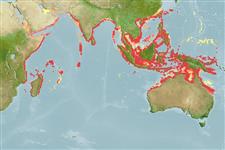
เกี่ยวกับทะเล,น้ำเค็ม; กร่อย pelagic-neritic; ปลาที่อพยพจากแหล่งน้ำเค็มไปวางไข่ในแหล่งน้ำจืด (Ref. 51243); ระดับความลึก 0 - 50 m (Ref. 82332). Tropical (Ref. 123745)
Indian Ocean: endemic off Mauritius (Ref. 123745). Its distribution in eastern coast of Africa, from Gulf of Aden to Zanzibar, northern Madagascar, eastward to Hong Kong and Papua New Guinea (Ref. 189) is based on misidentifications for other species: Stolephorus mercurius (SE Asia), S. rex (Indo-West Pacific) and S. zephyrus (eastern coast of Africa to Madagascar) (Ref. 123745).
ความยาวเมื่อครบกำหนดครั้งแรก / ขนาด / น้ำหนัก / อายุ
วัยเจริญพันธุ์: Lm 7.2 range ? - ? cm
Max length : 11.2 cm SL เพศผู้/กระเทย; (Ref. 123745)
เงี่ยงครีบก้น: 0; ก้านครีบอ่อนที่ก้น: 21 - 22. Diagnosis: Body somewhat compressed, belly a little rounded, with 0-5 small needle-like pre-pelvic scutes; maxilla tip pointed, reaching to or a little beyond hind border of pre-operculum, the latter convex, rounded; lower gillrakers usually 23 to 28; small teeth present on upper edge of hyoid bones; isthmus muscle tapering evenly forward to hind border of branchial membrane; pelvic fin tips reaching to below anterior dorsal finrays; anal fin short, with usually 3 unbranched and 18-19 branched finrays, its origin below second half of dorsal fin base; body light transparent fleshy brown, with a silver stripe down flank; a pair of dark patches behind occiput, followed by a pair of dark lines to dorsal fin origin (Ref. 189). It closely resembles Stolephorus apiensis of Fiji and Samoa, which lacks pigment lines before the dorsal fin; and S. brachycephalus of Papua New Guinea, which has more anal finrays, no hyoid teeth, and more scutes; Stolephorus waitei has characteristic spots on the lower part of the head, and the pelvic fins do not reach to the dorsal fin origin, as also in S. chinensis; other Stolephorus species have the hind border of the pre-operculum concave near the maxilla tip (Ref. 189).
Body shape (shape guide): elongated; Cross section: compressed.
A schooling fish found in coastal waters, apparently entering brackish water (Ref. 189), at depths of 0-50 m (Ref. 82332). It feeds on surface plankton, primarily copepods and prawn larvae (Ref. 189). Eggs are oval with a knob (Ref. 189). Used for food and fish meal (Ref. 4537).
Hata, H., S. Lavoué and H. Motomura, 2021. Taxonomic status of nominal species of the anchovy genus Stolephorus previously regarded as synonyms of Stolephorus commersonnii Lacepède 1803 and Stolephorus indicus (van Hasselt 1823), and descriptions of three new species (Clupeiformes: Engraulidae). Ichthyol. Res. 68(3):327-372. (Ref. 123745)
สถานะบัญชีแดงของ IUCN (Ref. 130435: Version 2025-2 (Global))
ภัยคุกคามต่อมนุษย์
Harmless
การใช้ของมนุษย์
การประมง: การค้า
เครื่องมือ
รายงานพิเศษ
ดาวน์โหลด XML
แหล่งที่มาจากอินเตอร์เน็ต
การประมาณค่าตามแบบจำลอง
อุณหภูมิที่ต้องการ (อ้างอิง
123201): 25 - 29.1, mean 28.3 °C (based on 1386 cells).
ดัชนีความหลากหลายทางวิวัฒนาการ (อ้างอิง
82804): PD
50 = 0.5000 [Uniqueness, from 0.5 = low to 2.0 = high].
Bayesian length-weight: a=0.00513 (0.00383 - 0.00686), b=3.15 (3.11 - 3.19), in cm total length, based on LWR estimates for this species (Ref.
93245).
ระดับชั้นอาหาร (อ้างอิง
69278): 3.1 ±0.20 se; based on food items.
ความสามารถในการกลับคืนสู่ปกติ (อ้างอิง
120179): ความสูง, เวลาต่ำสุดที่จะทำให้ประชากรเพิ่มขึ้นเป็น 2 เท่าใช้เวลาน้อยกว่า 15 เดือน (K=0.95-0.96).
ความเสี่ยงต่อการตกปลา (Ref.
59153): Low vulnerability (14 of 100).
🛈
สารอาหาร (Ref.
124155): Calcium = 449 [145, 1,234] mg/100g; Iron = 2.49 [1.36, 4.40] mg/100g; Protein = 19.1 [17.3, 21.0] %; Omega3 = 0.447 [0.194, 1.040] g/100g; Selenium = 46.6 [20.7, 99.9] μg/100g; VitaminA = 36.1 [7.7, 152.2] μg/100g; Zinc = 2.92 [1.90, 4.37] mg/100g (wet weight); based on
nutrient studies.