>
Saccopharyngiformes (Swallowers and gulpers) >
Monognathidae (Onejaws)
Etymology: Monognathus: Greek, monos = one + Greek, gnathos = jaw (Ref. 45335); boehlkei: Named for the late James E. Böhlke in recognition of his valuable contributions to the study of apodal fishes.
Eponymy: James Erwin Böhlke (1930–1982) and his wife Eugenia Louisa Böhlke née Brandt (1929–2001) were both ichthyologists who worked at the Academy of Natural Sciences of Philadelphia, where he was Curator of Ichthyology (1954–1982). [...] (Ref. 128868), visit book page.
More on authors: Bertelsen & Nielsen.
Ambiente: milieu / zona climática / intervalo de profundidade / gama de distribuição
Ecologia
marinhas batipelágico; intervalo de profundidade 2500 - 5430 m (Ref. 34506). Deep-water
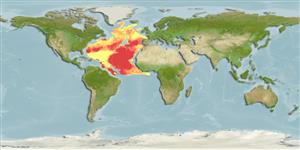
Atlantic Ocean: the holotype was caught near Bermuda and the paratypes southwest of Madeira.
Tamanho / Peso / Idade
Maturidade: Lm ? range ? - ? cm
Max length : 7.0 cm TL macho/indeterminado; (Ref. 34506)
Descrição breve
Chaves de identificação | Morfologia | Morfometria
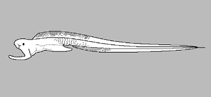
Raios dorsais moles (total) : 130 - 150; Raios anais moles: 110 - 130. M. boehlkei differs from all other species of the genus by the high number of anal fin rays (110-130 vs. 42-88) and by an obtuse angle between rostral fang and frontal profile of skull. It is further distinguished by the following combination of characters: head short, snout blunt, skull length4.2-5.2% TL, rostral fang with dorsal profile slightly concave, anal fin origin below dorsal fin rays number 7-13, pectoral fin 2-3% TL, lower jaw nearly straight, and 6 lateral, subdermal spots of pigmentation (Ref. 34506).
Body shape (shape guide): eel-like.
All specimens were taken in closing nets, one between 2500 and 3500 m with a bottom depth of 4563 m and the other specimens between 10-3- m above the bottom with soundings from 2960-5430 m (Ref. 34506).
Ciclo de vida e comportamento de acasalamento
Maturidade | Reprodução | Desova | Ovos | Fecundidade | Larvas
Bertelsen, E. and J.G. Nielsen, 1987. The deep sea eel family Monognathidae (Pisces, Anguilliformes). Steenstrupia 13(4):141-198. (Ref. 34506)
Categoria na Lista Vermelha da IUCN (Ref. 130435: Version 2025-2 (Global))
Ameaça para o homem
Harmless
Utilização humana
Pescarias: sem interesse
Ferramentas
Relatórios especiais
Descarregue XML
Fontes da internet
Estimativas baseadas em modelos
Temperatura preferida (Ref.
123201): 2.5 - 2.9, mean 2.7 °C (based on 105 cells).
Índice de diversidade filogenética (Ref.
82804): PD
50 = 0.5001 [Uniqueness, from 0.5 = low to 2.0 = high].
Bayesian length-weight: a=0.00102 (0.00046 - 0.00225), b=3.06 (2.88 - 3.24), in cm total length, based on all LWR estimates for this body shape (Ref.
93245).
Nível Trófico (Ref.
69278): 3.6 ±0.59 se; based on food items.
Vulnerabilidade da pesca (Ref.
59153): Low vulnerability (10 of 100).
🛈