>
Eupercaria/misc (Various families in series Eupercaria) >
Haemulidae (Grunts) > Plectorhinchinae
Etymology: Plectorhinchus: Greek, plektos = plaited + Greek, rhyngchos = snout (Ref. 45335).
More on author: Bleeker.
Environnement : milieu / zone climatique / profondeur / gamme de distribution
Écologie
marin récifal; profondeur 6 - 70 m (Ref. 90102). Tropical
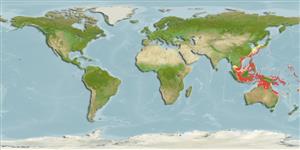
Western Pacific: Singapore and the Philippines to the Solomon Islands, north to the Ryukyu Islands, south to the Great Barrier Reef and New Caledonia.
Taille / Poids / Âge
Maturité: Lm ? range ? - ? cm
Max length : 41.0 cm SL mâle / non sexé; (Ref. 37816)
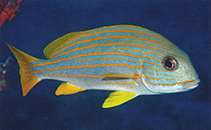
Épines dorsales (Total) : 13; Rayons mous dorsaux (Total) : 18 - 21; Épines anales: 3; Rayons mous anaux: 7 - 8. This species is distinguished by the following characters: chin with 6 pores, no median pit; gill rakers on first gill arch 9-12 + 1 + 18-21 = 28-33; D XIII,18-21, 3rd-5th spines longest; lips fleshy, moderately swollen with age; scales ctenoid (rough to touch); lateral line tubed scales about 53-58; body depth 2.7-2.8 in SL; caudal rounded or lanceolate in juveniles, becoming truncate or emarginate in adults. Colour of body and head bright blue-green to sky blue with 5 to 7 bright yellow longitudinal bands often separated by thinner yellow bands or lines of spots; fins bright yellow to orange; juveniles similar to adults, but with fewer bands (Ref. 47695, 90102).
Body shape (shape guide): fusiform / normal; Cross section: compressed.
In coastal reef slopes, inner reefs and deep lagoon (Ref. 48635). Prefers sheltered reefs and during the day either solitary or in large inactive aggregations (Ref. 34765).
Cycle de vie et comportement reproducteur
Maturité | Reproduction | Frai | Œufs | Fécondité | Larves
Oviparous, distinct pairing during breeding (Ref. 205).
Myers, R.F., 1999. Micronesian reef fishes. A comprehensive guide to the coral reef fishes of Micronesia. Coral Graphics, Barrigada, Guam. 216 p. (Ref. 34765)
Statut dans la liste rouge de l'IUCN (Ref. 130435: Version 2025-2 (Global))
Menace pour l'homme
Harmless
Utilisations par l'homme
Outils
Articles particuliers
Télécharger en XML
Sources Internet
Estimations basées sur des modèles
Température préférée (Réf.
123201): 24.7 - 29, mean 28.1 °C (based on 842 cells).
Indice de diversité phylogénétique (Réf.
82804): PD
50 = 0.5000 [Uniqueness, from 0.5 = low to 2.0 = high].
Bayesian length-weight: a=0.01349 (0.00626 - 0.02905), b=3.00 (2.83 - 3.17), in cm total length, based on LWR estimates for this Genus-body shape (Ref.
93245).
Niveau trophique (Réf.
69278): 3.5 ±0.50 se; based on food items.
Résilience (Réf.
120179): Milieu, temps minimum de doublement de population : 1,4 à 4,4 années (Preliminary K or Fecundity.).
Vulnérabilité de la pêche (Ref.
59153): Moderate vulnerability (40 of 100).
🛈
Nutriments (Ref.
124155): Calcium = 37.5 [13.5, 67.3] mg/100g; Iron = 0.54 [0.29, 0.95] mg/100g; Protein = 19.2 [17.3, 21.0] %; Omega3 = 0.137 [0.075, 0.215] g/100g; Selenium = 34.3 [20.5, 54.9] μg/100g; VitaminA = 85.5 [34.2, 202.4] μg/100g; Zinc = 1.16 [0.81, 1.68] mg/100g (wet weight);