>
Ovalentaria/misc (Various families in series Ovalentaria) >
Pomacentridae (Damselfishes) > Pomacentrinae
Etymology: Amblyglyphidodon: Greek, amblys = darkness + Greek, glyphis = carved + Greek, odous = teeth (Ref. 45335).
More on author: Cuvier.
Environnement : milieu / zone climatique / profondeur / gamme de distribution
Écologie
marin récifal; non migrateur; profondeur 0 - 60 m (Ref. 128797), usually 12 - 45 m (Ref. 9710). Tropical; 30°N - 24°S, 90°E - 174°W
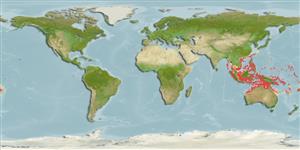
Western Pacific: Andaman Sea (Ref. 7247) and Christmas Island in the eastern Indian Ocean to Fiji, north to the Ryukyu Islands, south to Rowly Shoals (eastern Indian Ocean)and New Caledonia. Recently recorded from Tonga (Ref. 53797).
Taille / Poids / Âge
Maturité: Lm ? range ? - ? cm
Max length : 13.0 cm TL mâle / non sexé; (Ref. 48636)
Description synthétique
Clés d'identification | Morphologie | Morphométrie
Épines dorsales (Total) : 13; Rayons mous dorsaux (Total) : 12 - 16; Épines anales: 2; Rayons mous anaux: 14 - 15.
Body shape (shape guide): short and / or deep; Cross section: compressed.
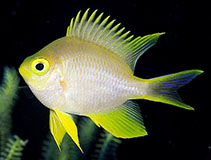
Adults occur in steep outer reef, occasionally in deep lagoons and along channel walls, usually in current prone habitats and where there are abundant gorgonian and long sea-whip corals on which they lay and guard eggs. Juveniles in small groups often found among large sea fans or black corals. Feed on zooplankton (Ref. 7247). Oviparous, distinct pairing during breeding (Ref. 205). Eggs are demersal and adhere to the substrate (Ref. 205). Eggs laid usually on gorgonian dead branches (Ref. 90102). Males guard and aerate the eggs (Ref. 205).
Cycle de vie et comportement reproducteur
Maturité | Reproduction | Frai | Œufs | Fécondité | Larves
Oviparous, distinct pairing during breeding (Ref. 205). Eggs are demersal and adhere to the substrate (Ref. 205). Males guard and aerate the eggs (Ref. 205).
Allen, G.R., 1991. Damselfishes of the world. Mergus Publishers, Melle, Germany. 271 p. (Ref. 7247)
Statut dans la liste rouge de l'IUCN (Ref. 130435: Version 2025-2 (Global))
Menace pour l'homme
Harmless
Utilisations par l'homme
Pêcheries: commercial; Aquarium: Commercial
Outils
Articles particuliers
Télécharger en XML
Sources Internet
Estimations basées sur des modèles
Température préférée (Réf.
123201): 26.1 - 29, mean 28.1 °C (based on 904 cells).
Indice de diversité phylogénétique (Réf.
82804): PD
50 = 0.5005 [Uniqueness, from 0.5 = low to 2.0 = high].
Bayesian length-weight: a=0.02344 (0.01149 - 0.04783), b=2.98 (2.80 - 3.16), in cm total length, based on LWR estimates for this (Sub)family-body shape (Ref.
93245).
Niveau trophique (Réf.
69278): 2.7 ±0.30 se; based on food items.
Résilience (Réf.
120179): Haut, temps minimum de doublement de population inférieur à 15 mois (Preliminary K or Fecundity.).
Vulnérabilité de la pêche (Ref.
59153): Low vulnerability (10 of 100).
🛈
Nutriments (Ref.
124155): Calcium = 96.8 [48.8, 148.6] mg/100g; Iron = 0.72 [0.45, 1.17] mg/100g; Protein = 18.2 [17.0, 19.3] %; Omega3 = 0.116 [0.072, 0.185] g/100g; Selenium = 27.1 [15.4, 48.9] μg/100g; VitaminA = 81.4 [22.0, 272.3] μg/100g; Zinc = 1.64 [1.13, 2.35] mg/100g (wet weight);