>
Ovalentaria/misc (Various families in series Ovalentaria) >
Pomacentridae (Damselfishes) > Pomacentrinae
Etymology: Dischistodus: Greek, di = two + Greek, schistos = fissile stone, Plinius + Greek, odous = teeth (Ref. 45335).
More on author: Cuvier.
Ambiente: milieu / zona climática / intervalo de profundidade / gama de distribuição
Ecologia
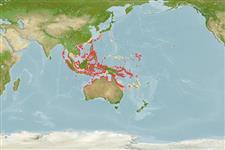
marinhas; estuarina associadas(os) a recifes; não migratória; intervalo de profundidade 1 - 10 m (Ref. 7247). Tropical; 32°N - 25°S, 92°E - 171°E
Indo-West Pacific: eastern Indian Ocean from the Andaman Sea, Rowley Shoals (Ref. 9710) and northwest Australia eastward to the Solomon Islands, north to China, south to the Great Barrier Reef.
Tamanho / Peso / Idade
Maturidade: Lm ? range ? - ? cm
Max length : 18.0 cm TL macho/indeterminado; (Ref. 48636)
Descrição breve
Chaves de identificação | Morfologia | Morfometria
Espinhos dorsais (total) : 13; Raios dorsais moles (total) : 13 - 15; Espinhos anais: 2; Raios anais moles: 14 - 15.
Body shape (shape guide): fusiform / normal; Cross section: oval.
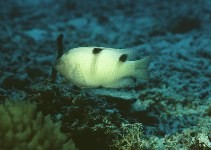
Adults occur in small patch reefs of shallow lagoons, with algae or seagrass habitats. The stomach of several specimens examined contained mainly algae and detritus mixed with sand grains (Ref. 7247). Oviparous, distinct pairing during breeding (Ref. 205). Eggs are demersal and adhere to the substrate (Ref. 205). Males guard and aerate the eggs (Ref. 205). Diurnal species (Ref. 113699).
Ciclo de vida e comportamento de acasalamento
Maturidade | Reprodução | Desova | Ovos | Fecundidade | Larvas
Oviparous, distinct pairing during breeding (Ref. 205). Eggs are demersal and adhere to the substrate (Ref. 205). Males guard and aerate the eggs (Ref. 205).
Allen, G.R., 1991. Damselfishes of the world. Mergus Publishers, Melle, Germany. 271 p. (Ref. 7247)
Categoria na Lista Vermelha da IUCN (Ref. 130435: Version 2025-2 (Global))
Ameaça para o homem
Harmless
Utilização humana
Pescarias: pouco comercial
Ferramentas
Relatórios especiais
Descarregue XML
Fontes da internet
Estimativas baseadas em modelos
Temperatura preferida (Ref.
123201): 25.4 - 29.3, mean 28.7 °C (based on 2212 cells).
Índice de diversidade filogenética (Ref.
82804): PD
50 = 0.5078 [Uniqueness, from 0.5 = low to 2.0 = high].
Bayesian length-weight: a=0.01445 (0.00624 - 0.03346), b=3.00 (2.81 - 3.19), in cm total length, based on LWR estimates for this (Sub)family-body shape (Ref.
93245).
Nível Trófico (Ref.
69278): 2.0 ±0.00 se; based on food items.
Resiliência (Ref.
120179): Médio, tempo mínimo de duplicação da população 1,4 - 4,4 anos (Preliminary K or Fecundity.).
Vulnerabilidade da pesca (Ref.
59153): Low vulnerability (10 of 100).
🛈
Nutrientes (Ref.
124155): Calcium = 91.2 [45.3, 162.6] mg/100g; Iron = 0.733 [0.416, 1.217] mg/100g; Protein = 18.7 [17.5, 19.8] %; Omega3 = 0.122 [0.072, 0.206] g/100g; Selenium = 19.5 [10.7, 40.0] μg/100g; VitaminA = 95.9 [27.6, 330.8] μg/100g; Zinc = 2.52 [1.72, 3.69] mg/100g (wet weight);