>
Eupercaria/misc (Various families in series Eupercaria) >
Labridae (Wrasses) > Labrinae
Etymology: Labrus: Name from Latin 'labrum' for lip, rim or edge; referring to the big lips of the fishes of the genus (from Ovid and Pliny according to Petrus Artedi).
Environnement : milieu / zone climatique / profondeur / gamme de distribution
Écologie
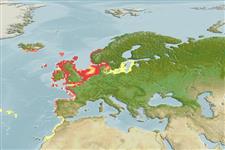
marin récifal; profondeur 1 - 50 m (Ref. 5292), usually 2 - 30 m (Ref. 35388). Temperate; 5°C - 25°C (Ref. 132294); 64°N - 27°N, 32°W - 22°E
Eastern Atlantic: Norway to Morocco, including Madeira, the Azores and the Canary Islands. Doubtful reports from Mediterranean, Adriatic and Marmara seas (Ref. 4742), where it is often confused with Labrus merula.
Longueur à la première maturité / Taille / Poids / Âge
Maturité: Lm ? range ? - ? cm
Max length : 65.9 cm TL mâle / non sexé; (Ref. 40637); common length : 50.0 cm SL mâle / non sexé; (Ref. 4742); poids max. publié: 4.4 kg (Ref. 40637); âge max. reporté: 34 années (Ref. 131345)
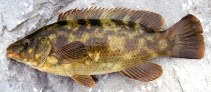
Body rather massive. Mouth small with thick lips and large conical teeth. Coloration very variable, brownish and greenish predominating (Ref. 35388).
Body shape (shape guide): fusiform / normal.
Adults are found in littoral (10-20 m) zone around rocks, offshore reefs, and seaweed. Young often in intertidal areas. All are born females and change sex when they are 4-14 years old (Ref. 35388). One (or more) female spawns in nest of algae, built by male in a crevice. Feed on crustaceans and mollusks (Ref. 4742). Oviparous (Ref. 205).
Eggs are laid in nest built from algae; male guards nest 1-2 weeks until larvae hatch (Ref. 35388); larvae are pelagic.
Quignard, J.-P. and A. Pras, 1986. Labridae. p. 919-942. In P.J.P. Whitehead, M.-L. Bauchot, J.-C. Hureau, J. Nielsen and E. Tortonese (eds.) Fishes of the north-eastern Atlantic and the Mediterranean. UNESCO, Paris. Vol. 2. (Ref. 4742)
Statut dans la liste rouge de l'IUCN (Ref. 130435: Version 2025-2 (Global))
Menace pour l'homme
Harmless
Utilisations par l'homme
Pêcheries: pêcheries vivrières; pêche sportive: oui; Aquarium: Commercial
Outils
Articles particuliers
Télécharger en XML
Sources Internet
Estimations basées sur des modèles
Température préférée (Réf.
123201): 8.7 - 13.3, mean 10.5 °C (based on 376 cells).
Indice de diversité phylogénétique (Réf.
82804): PD
50 = 0.5625 [Uniqueness, from 0.5 = low to 2.0 = high].
Bayesian length-weight: a=0.00977 (0.00563 - 0.01695), b=3.07 (2.92 - 3.22), in cm total length, based on LWR estimates for this species & (Sub)family-body (Ref.
93245).
Niveau trophique (Réf.
69278): 3.2 ±0.0 se; based on diet studies.
Résilience (Réf.
120179): Faible, temps minimum de doublement de population : 4,5 à 14 années (K=0.1; tmax=34; tm=2-9).
Vulnérabilité de la pêche (Ref.
59153): Moderate to high vulnerability (51 of 100).
🛈
Vulnérabilité climatique (Ref.
125649): High to very high vulnerability (75 of 100).
🛈
Nutriments (Ref.
124155): Calcium = 10.7 [4.4, 18.8] mg/100g; Iron = 0.168 [0.091, 0.360] mg/100g; Protein = 18.7 [15.8, 21.0] %; Omega3 = 0.302 [0.162, 0.565] g/100g; Selenium = 7.99 [3.73, 17.31] μg/100g; VitaminA = 54.7 [13.8, 262.4] μg/100g; Zinc = 0.647 [0.426, 1.163] mg/100g (wet weight);