>
Argentiniformes (Marine smelts) >
Microstomatidae (Pencil smelts)
Eponymy: Fridtjof Nansen (1861–1930) was a Norwegian explorer, scientist, diplomat and later recipient of the Nobel Peace Prize. [...] (Ref. 128868), visit book page.
Environnement : milieu / zone climatique / profondeur / gamme de distribution
Écologie
marin benthopélagique; profondeur 0 - 865 m (Ref. 5123). Subtropical; 35°N - 7°S
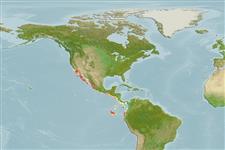
Eastern Pacific: southern region of California Current south of 35°N.
Taille / Poids / Âge
Maturité: Lm ? range ? - ? cm
Max length : 26.6 cm SL (female)
Description synthétique
Clés d'identification | Morphologie | Morphométrie
Épines dorsales (Total) : 0; Rayons mous dorsaux (Total) : 9 - 10; Épines anales: 0; Rayons mous anaux: 8 - 9; Vertèbres: 43 - 46. Branchiostegal rays 4. Predorsal length greater than 49% SL. Caudal peduncle length greater than 13% SL; depth less than 8% SL in specimens more than 3 cm (Ref. 5123).
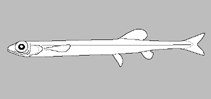
Body shape (shape guide): elongated.
Adults are found in continental slope regions. Oviparous, with planktonic eggs and larvae (Ref. 35612). Larvae and juveniles pelagic in the upper 200-m layer and more broadly distributed than adults (Ref. 5123).
Cycle de vie et comportement reproducteur
Maturité | Reproduction | Frai | Œufs | Fécondité | Larves
Moser, H.G. and J.L. Butler, 1996. Microstomatidae: argentines and pencilfishes. p. 208-215. In H.G. Moser (ed.) The early stages of fishes in the California Current Region. California Cooperative Oceanic Fisheries Investigations (CalCOFI) Atlas No. 33. 1505 p. (Ref. 35612)
Statut dans la liste rouge de l'IUCN (Ref. 130435: Version 2025-2 (Global))
Menace pour l'homme
Harmless
Utilisations par l'homme
Outils
Articles particuliers
Télécharger en XML
Sources Internet
Estimations basées sur des modèles
Température préférée (Réf.
123201): 7.8 - 14.8, mean 11.4 °C (based on 35 cells).
Indice de diversité phylogénétique (Réf.
82804): PD
50 = 0.5000 [Uniqueness, from 0.5 = low to 2.0 = high].
Bayesian length-weight: a=0.00389 (0.00180 - 0.00842), b=3.12 (2.94 - 3.30), in cm total length, based on all LWR estimates for this body shape (Ref.
93245).
Niveau trophique (Réf.
69278): 3.4 ±0.4 se; based on size and trophs of closest relatives
Vulnérabilité de la pêche (Ref.
59153): Low vulnerability (22 of 100).
🛈