Klassifizierung / Names
Namen | Synonyme | Catalog of Fishes(Gattung, Arten) | ITIS | CoL | WoRMS | Cloffa
>
Eupercaria/misc (Various families in series Eupercaria) >
Labridae (Wrasses) > Labrinae
Etymology: Symphodus: Greek, syn, symphysis = grown together + Greek, odous = teeth (Ref. 45335); caeruleus: Named for th edistinctive blue coloration of males.
Umwelt: Milieu / Klimazone / Tiefenbereich / Verbreitungsgebiet
Ökologie
seewasser demersal; standorttreu; tiefenbereich 1 - 30 m (Ref. 35939), usually 5 - 15 m (Ref. 35939). Tropical; 39°N - 36°N, 32°W - 24°W
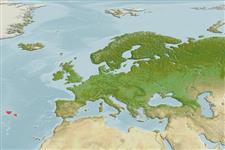
Northeast Atlantic: Madeira, Canary Islands and the Azores Islands.
Größe / Gewicht / Alter
Geschlechtsreife: Lm ? range ? - ? cm
Max length : 21.5 cm SL Männchen/unbestimmt; (Ref. 35939); 17.5 cm SL (female)
Kurzbeschreibung
Bestimmungsschlüssel | Morphologie | Morphometrie
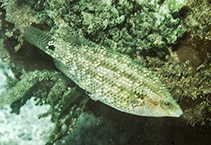
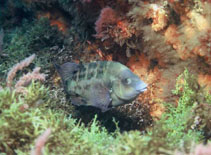
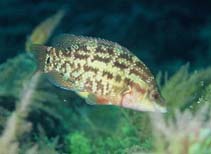
Rückenflossenstacheln (insgesamt) : 17 - 18; Rückenflossenweichstrahlen (insgesamt) : 8 - 9; Afterflossenstacheln: 5 - 6; Afterflossenweichstrahlen: 7 - 9. Modal count of rays on dorsal fin 26 and anal fin 14; scales on lateral line 33-34; dark blue coloration of the males during spawning season (Ref. 35939).
Body shape (shape guide): fusiform / normal; Cross section: compressed.
Oviparous, distinct pairing during breeding (Ref. 205). Males build dish shaped nests and guard the eggs (Ref. 205).
Lebenszyklus und Paarungsverhalten
Geschlechtsreife | Fortpflanzung | Ablaichen | Eier | Fruchtbarkeit | Larven
Oviparous, distinct pairing during breeding (Ref. 205). Males build dish shaped nests and guard the eggs (Ref. 205).
Azevedo, M., 1999. Centrolabrus caeruleus sp.nov., a long unrecognized species of marine fish (Teleostei, Labridae) from the Azores. Bocagiana 196:1-11. (Ref. 35939)
IUCN Rote Liste Status (Ref. 130435: Version 2025-2 (Global))
Bedrohung für Menschen
Harmless
Nutzung durch Menschen
Tools
Zusatzinformationen
Download XML
Internet Quellen
Schätzungen auf der Grundlage von Modellen
Bevorzugte Temperatur (Ref.
123201): 18.7 - 19.1, mean 18.8 °C (based on 9 cells).
Phylogenetischer Diversitätsindex (Ref.
82804): PD
50 = 0.5005 [Uniqueness, from 0.5 = low to 2.0 = high].
Bayesian length-weight: a=0.01023 (0.00486 - 0.02155), b=3.07 (2.90 - 3.24), in cm total length, based on LWR estimates for this Genus-body shape (Ref.
93245).
Trophische Ebene (Ref.
69278): 3.5 ±0.5 se; based on size and trophs of closest relatives
Widerstandsfähigkeit (Ref.
120179): mittel, Verdopplung der Population dauert 1,4 - 4,4 Jahre. (Preliminary K or Fecundity.).
Anfälligkeit der Fischerei (Ref.
59153): Low vulnerability (16 of 100).
🛈