Entorno: milieu / zona climática / rango de profundidad / gama de distribución
Ecología
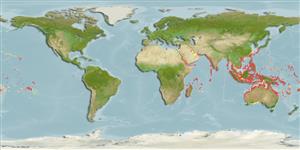
marino; salobre asociado a arrecife; rango de profundidad 0 - 30 m (Ref. 128797). Tropical; 22°C - 28°C; 32°N - 35°S, 20°E - 130°W
Indo-Pacific: Red Sea and East Africa and Persian Gulf (Ref. 68964) to the Tuamoto Islands, north to southern Japan, south to northern Australia and New Caledonia. Recorded off the coast of Florida in the Western Central Atlantic (Ref. 51238).
Tamaño / Peso / Edad
Madurez: Lm ? range ? - ? cm
Max length : 60.0 cm TL macho / no sexado; (Ref. 5450)
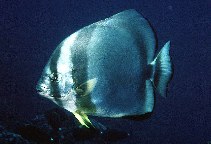
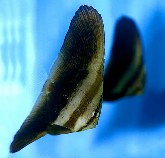
Espinas dorsales (total) : 5; Radios blandos dorsales (total) : 34 - 39; Espinas anales: 3; Radios blandos anales: 25 - 29. The ocular band of adult specimens with a series of dark vermiculations (Ref. 1602). Adults (above 20 cm) yellowish silvery or dusky, dark bar through eye and another bar just behind head. Occasionally with a few small, scattered black spots on body. Median fins yellowish, with black margins posteriorly. Pelvic fins black. Small juveniles reddish brown, with irregular black spots and blotches and small, white (black-edged) ocelli on body. Small black spot at base of last 3 dorsal- and anal-fin rays. Caudal fin transparent except for base, which is reddish brown. Body orbicular and strongly compressed, its depth more than twice length of head and 0.9 to 1.4 times SL. Head length 3.4 to 3.8 times SL. Snout profile of large adults (above 40 cm total length) concave, with bony swelling between eyes. Interorbital width 38 to 48% head length. Jaws with bands of slender, flattened, tricuspid teeth, the middle cusp about twice length of lateral cusps. No teeth on palatines or vomer. Five pores on each side of lower jaw. Preopercle smooth. Opercle without spines (Ref 43039).
Body shape (shape guide): short and / or deep; Cross section: compressed.
Live in shallow protected coastal waters to deep, somewhat silty habitats. Often with deep shipwrecks (Ref. 48637). Adults are found singly or in small groups and occasionally in large schools in some areas. Juveniles occur singly or in small groups among mangroves and inner sheltered lagoons while adults move out to open waters over sandy areas of deep lagoons, channels, and seaward reefs to a depth of at least 30 m. Feed on algae, invertebrates and small fishes (Ref. 89972).
Ciclo vital y comportamiento de apareamiento
Madurez | Reproducción | Puesta | Huevos | Fecundidad | Larva
Myers, R.F., 1991. Micronesian reef fishes. Second Ed. Coral Graphics, Barrigada, Guam. 298 p. (Ref. 1602)
Situación en la Lista Roja de la UICN (Ref. 130435: Version 2025-2 (Global))
Amenaza para el ser humano
Harmless
Usos humanos
Pesquerías: escaso valor comercial; Acuicultura: comercial; Acuario: Comercial
Herramientas
Informes especiales
Descargar XML
Fuentes de Internet
Estimaciones basadas en modelos
Temperatura preferida (Referencia
123201): 24.9 - 29.2, mean 28.5 °C (based on 3165 cells).
Índice de diversidad filogenética (Referencia
82804): PD
50 = 0.5313 [Uniqueness, from 0.5 = low to 2.0 = high].
Bayesian length-weight: a=0.03311 (0.01653 - 0.06635), b=2.95 (2.77 - 3.13), in cm total length, based on LWR estimates for this species & (Sub)family-body (Ref.
93245).
Nivel trófico (Referencia
69278): 3.3 ±0.49 se; based on food items.
Resiliencia (Referencia
120179): Medio, población duplicada en un tiempo mínimo de 1.4-4.4 años (Preliminary K or Fecundity.).
Vulnerabilidad pesquera (Ref.
59153): Moderate vulnerability (44 of 100).
🛈
Nutrientes (Ref.
124155): Calcium = 35.1 [18.3, 56.0] mg/100g; Iron = 0.48 [0.30, 0.77] mg/100g; Protein = 19 [18, 20] %; Omega3 = 0.0993 [, ] g/100g; Selenium = 32.3 [18.4, 59.2] μg/100g; VitaminA = 41.7 [11.6, 145.4] μg/100g; Zinc = 1.13 [0.79, 1.61] mg/100g (wet weight);