Klassifizierung / Names
Namen | Synonyme | Catalog of Fishes(Gattung, Arten) | ITIS | CoL | WoRMS | Cloffa
>
Cichliformes (Cichlids, convict blennies) >
Cichlidae (Cichlids) > Geophaginae
Etymology: Biotoecus: Greek, biotos, ou = life, existence + Greek, oikos = house, habitat (Ref. 45335); dicentrarchus: Named for the 2 anal fin spines, Greek prefix 'di' for two and nouns 'kentron' for spine and 'archos' for vent; noun in apposition (Ref. 86446).
More on author: Kullander.
Umwelt: Milieu / Klimazone / Tiefenbereich / Verbreitungsgebiet
Ökologie
; süßwasser benthopelagisch. Tropical
South America: Orinoco River basin, from the Inírida River (Colombia) to Maripa, (Venezuela)
Größe / Gewicht / Alter
Geschlechtsreife: Lm ? range ? - ? cm
Max length : 3.8 cm SL Männchen/unbestimmt; (Ref. 36377)
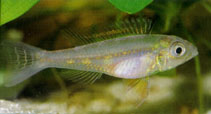
Rückenflossenstacheln (insgesamt) : 7 - 8; Rückenflossenweichstrahlen (insgesamt) : 14 - 16; Afterflossenstacheln: 2; Afterflossenweichstrahlen: 6 - 8. This species is distinguished from all other cichlids by having only two (vs. three or more) anal spines; differs from B. opercularis by lacking anguloarticular lateralis canal; 3 or 4 (vs. 5) skin openings and 2 or 3 (vs. 4) canal fragments representing the dentary lateralis canal; dorsal fin with slightly prolonged anterior spines and lappets; modal dorsal fin count VII.15 (vs. VIII.14); and 6 (vs. 5) dark spots along the middle of the side (Ref. 86446).
Body shape (shape guide): elongated; Cross section: compressed.
The type locality was a shallow laguna about 25 m wide, with transparent water, vegetation resembling needlegrass; water temperature 34°C; associated with another cichlid species,
Crenicara filamentosum, the dominant species at the locality (Ref. 86446).
Lebenszyklus und Paarungsverhalten
Geschlechtsreife | Fortpflanzung | Ablaichen | Eier | Fruchtbarkeit | Larven
Eggs are deposited at the ceiling of a cave; the female tends to eggs and yolk-sac larvae; both parents care for the free-swimming young (Ref. 42051).
Kullander, S.O., 2003. Cichlidae (Cichlids). p. 605-654. In R.E. Reis, S.O. Kullander and C.J. Ferraris, Jr. (eds.) Checklist of the Freshwater Fishes of South and Central America. Porto Alegre: EDIPUCRS, Brasil. (Ref. 36377)
IUCN Rote Liste Status (Ref. 130435: Version 2025-2 (Global))
Bedrohung für Menschen
Harmless
Nutzung durch Menschen
Fischereien: nicht kommerziell
Tools
Zusatzinformationen
Download XML
Internet Quellen
Schätzungen auf der Grundlage von Modellen
Phylogenetischer Diversitätsindex (Ref.
82804): PD
50 = 0.7500 [Uniqueness, from 0.5 = low to 2.0 = high].
Bayesian length-weight: a=0.00724 (0.00283 - 0.01852), b=3.13 (2.91 - 3.35), in cm total length, based on LWR estimates for this (Sub)family-body shape (Ref.
93245).
Trophische Ebene (Ref.
69278): 3.1 ±0.4 se; based on size and trophs of closest relatives
Widerstandsfähigkeit (Ref.
120179): mittel, Verdopplung der Population dauert 1,4 - 4,4 Jahre. (Assuming Fec<1000).
Anfälligkeit der Fischerei (Ref.
59153): Low vulnerability (10 of 100).
🛈