>
Blenniiformes (Blennies) >
Chaenopsidae (Pike-, tube- and flagblennies)
Etymology: Emblemariopsis: Latin, emblema = insertion, inlaid work, raised ornament + Greek, opsis = appearance (Ref. 45335).
Môi trường: môi trường / vùng khí hậu / Mức độ sâu / phạm vi phân phối
Sinh thái học
biển cùng sống ở rạn san hô; không di cư; mức độ sâu 0 - 20 m (Ref. 125603). Tropical
Western Central Atlantic: disjunct distribution; Colombia, Venezuela and Tobago.
Bộ gần gũi / Khối lượng (Trọng lượng) / Tuổi
Chín muồi sinh dục: Lm ? range ? - ? cm
Max length : 3.1 cm SL con đực/không giới tính; (Ref. 51458)
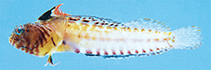
Các tia vây lưng cứng (tổng cộng) : 19 - 21; Các vây lưng mềm (tổng cộng) : 11 - 13; Tia cứng vây hậu môn: 2; Tia mềm vây hậu môn: 18 - 22. This species is distinguished by the following characters: an orbital cirrus and a red banner; terminal phase (TP) territorial males in holes with a black head and blackened anterior dorsal fin with a distal red band over a narrow white band and a thin white margin, the red band extending posteriorly to 5-7th spinous membrane, typically forming a straight line when fully erected in displaying TP (or a high crescent when not erected), with a narrow anterior flap variably present along first spine; first three dorsal-fin spines are elongated, first spine reaching to 7-10th spine base when adpressed, more than 3/4 HL, 21-23% SL, second spine 80-90% of first, third spine 65-80% of first, fourth to tenth spine about 1/2 to 2/3 of first; profile of anterior dorsal fin is usually a broad down-sloping concavity due to shorter middle-fin spines (unless fully erected). Colouration: dark-shaded and pale TP with a red-banded dorsal fin with irregular rows of larger dark spots along membranes of mid and posterior spinous-dorsal fin, lower operculum and branchiostegal membranes with prominent wider dark bands alternating with pale bands and/or white lines (= banded-operculum group), absence of a row of discrete small dark spots along anterior lateral midline, sometimes a row of dark spots along anterior upper body; transitional males with elongated anterior two dorsal-fin spines with a distal red band over reticulated brown to orange bands on first few membranes. Initial phase (IP) with elongated first two dorsal-fin spines, usually orange-tipped membranes, the first spine reaching to base of 6-8th spine base when adpressed, the second slightly shorter, third about 1/2 of first (earlier IP and juvenile with less elongate spines); colors when alive include red, orange, and pink; cranial pattern not well documented; IP head spots usually full complement; anterior upper body frequently speckled; melanophores near the pectoral-fin base typically form a long, thin, slightly oblique bar, often followed by one or more spots (Ref. 125603).
Body shape (shape guide): elongated; Cross section: oval.
Occurs in coral and rocky coral reefs and even on harbor pilings, but not in high-energy zones. Males occupied barnacle shells and worm holes, empty cirripede shells placed among dead Millepora, while females were on the hard surface, in crevices and on corals, especially Montastrea annularis. Apparently this species avoids high-energy areas, going deep when necessary (Ref. 125603).
Vòng đời và hành vi giao phối
Chín muồi sinh dục | Sự tái sinh sản | Đẻ trứng | Các trứng | Sự sinh sản | Ấu trùng
Victor, B.C., 2020. Review of the glass blennies (Teleostei: Chaenopsidae: Emblemariopsis) with two new species from the Caribbean Sea. J. Ocean Sci. Found. 37:1-122. (Ref. 125603)
Tình trạng Sách đỏ IUCN (Ref. 130435: Version 2025-2 (Global))
Mối đe dọa đối với con người
Harmless
Sử dụng của con người
Các công cụ
Báo cáo đặc biệt
Tải xuống XML
Các nguồn internet
Ước tính dựa trên mô hình
Chỉ số đa dạng phát sinh loài (Tài liệu tham khảo
82804): PD
50 = 0.5001 [Uniqueness, from 0.5 = low to 2.0 = high].
Bayesian length-weight: a=0.00525 (0.00224 - 0.01232), b=3.07 (2.86 - 3.28), in cm total length, based on LWR estimates for this (Sub)family-body shape (Ref.
93245).
Mức dinh dưỡng (Tài liệu tham khảo
69278): 3.3 ±0.5 se; based on size and trophs of closest relatives
Sự dễ bị tổn thương của nghề đánh cá (Ref.
59153): Low vulnerability (10 of 100).
🛈