Elasmobranquios (tiburones y rayas) (sharks and rays) >
Carcharhiniformes (Ground sharks) >
Pentanchidae (Deepwater catsharks)
Etymology: Asymbolus: Etymology not explained, possibly a-, Latin privative, i.e., without; sym-, from syn (Gr.), together or joined; bolus (L.), lump or morsel, proposed as a subgenus of Scyliorhinus (Scyliorhinidae) distinguished in part by labial fold of upper lip not hanging over lower-jaw symphysis of A. analis and A. vincenti (See ETYFish); rubiginosus: Latin for rusty, referring to its body coloration (See ETYFish).
More on authors: Last, Gomon & Gledhill.
Entorno: milieu / zona climática / rango de profundidad / gama de distribución
Ecología
marino pelagic-oceanic; rango de profundidad 25 - 540 m (Ref. 36718). Subtropical
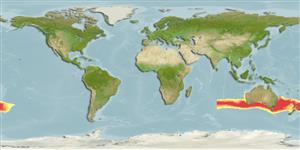
Eastern Indian Ocean: Australia
Tamaño / Peso / Edad
Madurez: Lm ? range ? - ? cm
Max length : 39.3 cm TL macho / no sexado; (Ref. 36718); 41.9 cm TL (female)
Descripción breve
Claves de identificación | Morfología | Morfometría
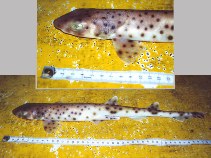
Pale brownish medium-sized body with orange brown spots; indistinct brownish blotch beneath eye; between each dark saddle on dorsal midline a cluster of spots; caudal peduncle short and slender; head and trunk broad, anal-fin base long.
Body shape (shape guide): elongated.
Ciclo vital y comportamiento de apareamiento
Madurez | Reproducción | Puesta | Huevos | Fecundidad | Larva
Oviparous, paired eggs are laid. Embryos feed solely on yolk (Ref. 50449).
Last, P.R., M.F. Gomon and D.C. Gledhill, 1999. Australian spotted catsharks of the genus Asymbolus (Carcharhiniformes: Scyliorhinidae). Part 2: Descriptions of three new, dark-spotted species. p. 19-35. In P.R. Last (ed.). Australian catsharks of the genus Asymbolus (Carcharhiniformes: Scyliorhinidae). (Ref. 36718)
Situación en la Lista Roja de la UICN (Ref. 130435: Version 2025-2 (Global))
Amenaza para el ser humano
Harmless
Usos humanos
Pesquerías: bycatch
Herramientas
Informes especiales
Descargar XML
Fuentes de Internet
Estimaciones basadas en modelos
Temperatura preferida (Referencia
123201): 12.1 - 17, mean 14.6 °C (based on 55 cells).
Índice de diversidad filogenética (Referencia
82804): PD
50 = 0.5020 [Uniqueness, from 0.5 = low to 2.0 = high].
Bayesian length-weight: a=0.00347 (0.00172 - 0.00698), b=3.08 (2.90 - 3.26), in cm total length, based on LWR estimates for this (Sub)family-body shape (Ref.
93245).
Nivel trófico (Referencia
69278): 4.0 ±0.5 se; based on size and trophs of closest relatives
Resiliencia (Referencia
120179): Bajo, población duplicada en un tiempo mínimo de 4.5-14 años (Fec assumed to be <100).
Vulnerabilidad pesquera (Ref.
59153): Low to moderate vulnerability (32 of 100).
🛈