>
Kurtiformes (Nurseryfishes, cardinalfishes.) >
Apogonidae (Cardinalfishes) > Apogoninae
Etymology: Taeniamia: Name from feminine Latin noun 'taenia' meaning ribbon or band; and feminine Greek noun 'Amia' meaning a fish, often used with cardinalfishes genera. Here as Taeniamia referring to the vertical wide bars and near vertical to curved narrow bars as lines on most of the species in this genus.
More on author: Bleeker.
Environnement : milieu / zone climatique / profondeur / gamme de distribution
Écologie
marin récifal; profondeur 1 - 40 m (Ref. 54391), usually 2 - 15 m (Ref. 90102). Tropical; 30°N - 23°S
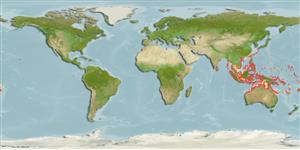
Western Pacific: from Indonesia to Vanuatu, north to the Ryukyu Islands, south to Australia.
Taille / Poids / Âge
Maturité: Lm ? range ? - ? cm
Max length : 8.0 cm TL mâle / non sexé; (Ref. 9710); common length : 6.1 cm SL mâle / non sexé; (Ref. 37816)
Description synthétique
Clés d'identification | Morphologie | Morphométrie
Épines dorsales (Total) : 7; Rayons mous dorsaux (Total) : 9; Épines anales: 2; Rayons mous anaux: 14 - 16. Diagnosis: Rays: dorsal VI + I,9; anal II,14-16 (rarely 13 or 17); pectoral rays 13-14 (rarely 12). Gill rakers 5-7 + 14-17 (total, 19-23). Lateral-line scales 25+3-4 (rarely 27 or 30). Median predorsal scales 6-7 (rarely 5). Body depth 2.5-2.8 in SL; body width 2.3-2.65 in body depth; eye diameter 2.7-3.2 in head length; first dorsal spine 1.5-1.9 in second spine; second dorsal spine 2.35-3.0, and third dorsal spine 2.35-3.1 in head length; spine of second dorsal fin 2.2-2.6, and second anal spine 2.5-3.1 in head length; pelvic-fin length 4.5-5.1; caudal-peduncle length 4.5-5.4 in SL. Distance from insertion of pelvic spine to anal-fin origin 4.1-5.5 in SL Preopercular edge serrate. Scaly sheath along anal-fin base moderately developed (Ref. 54391).
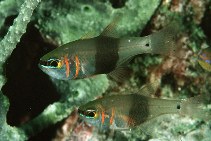
Some geographical variations. Usually a black band below second dorsal fin, but highly variable in width and may fade to barely a trace, or is completely absent. In Japanese and Indian Ocean populations, the band is usually narrow and often absent. Best identified by the two vertical orange stripes over gills and distinctive black peduncular spot (Ref. 48635).
Body shape (shape guide): short and / or deep; Cross section: compressed.
Forms dense aggregations above or among the branches of Porites cylindrica and other branching corals (e.g. Acropora Ref. 54391) of sheltered lagoons and inshore bays (Ref. 1602); over sandy bottom at depths of 1-40 meters (Ref. 54391). Nocturnal species (Ref. 7300).
Cycle de vie et comportement reproducteur
Maturité | Reproduction | Frai | Œufs | Fécondité | Larves
Are mouthbrooders (Ref. 240). Distinct pairing during courtship and spawning (Ref. 205).
Gon, O. and J.E. Randall, 2003. Revision of the Indo-Pacific cardinalfish genus Archamia (Perciformes: Apogonidae), with description of a new species. Indo-Pac. Fish. (35):49 p. (Ref. 54391)
Statut dans la liste rouge de l'IUCN (Ref. 130435: Version 2025-2 (Global))
Menace pour l'homme
Harmless
Utilisations par l'homme
Outils
Articles particuliers
Télécharger en XML
Sources Internet
Estimations basées sur des modèles
Température préférée (Réf.
123201): 26.1 - 29.3, mean 28.7 °C (based on 2277 cells).
Indice de diversité phylogénétique (Réf.
82804): PD
50 = 0.5001 [Uniqueness, from 0.5 = low to 2.0 = high].
Bayesian length-weight: a=0.01380 (0.00740 - 0.02573), b=3.01 (2.85 - 3.17), in cm total length, based on LWR estimates for this species & (Sub)family-body (Ref.
93245).
Niveau trophique (Réf.
69278): 3.5 ±0.50 se; based on food items.
Résilience (Réf.
120179): Haut, temps minimum de doublement de population inférieur à 15 mois (Preliminary K or Fecundity.).
Vulnérabilité de la pêche (Ref.
59153): Low vulnerability (10 of 100).
🛈
Nutriments (Ref.
124155): Calcium = 174 [85, 306] mg/100g; Iron = 1.13 [0.62, 2.03] mg/100g; Protein = 18.6 [17.3, 19.8] %; Omega3 = 0.135 [0.070, 0.263] g/100g; Selenium = 36.8 [16.9, 75.9] μg/100g; VitaminA = 53.8 [14.3, 202.5] μg/100g; Zinc = 1.97 [1.25, 3.01] mg/100g (wet weight);