>
Cichliformes (Cichlids, convict blennies) >
Cichlidae (Cichlids) > Cichlasomatinae
Etymology: Mesonauta: Name not explained by Günther; probably from the Greek 'mesos' meaning middle or average, and 'nautes' for sailo (alternatively from Latin 'nauta' or sailor; the name perhaps refers to he position of dorsal fin origin posterior to the pelvic fin which was the author's principal diagnostic character; egregius: Name from a Latin adjective 'egregius' meaning eminent or distinguished.
More on authors: Kullander & Silfvergrip.
Environnement : milieu / zone climatique / profondeur / gamme de distribution
Écologie
; eau douce benthopélagique; pH range: 4.8 - ? ; dH range: 0 - ?. Tropical; ? - 30°C (Ref. 40602)
South America: Orinocoa River basin, in the Meta and Vichada River basins.
Taille / Poids / Âge
Maturité: Lm ? range ? - ? cm
Max length : 8.2 cm SL mâle / non sexé; (Ref. 36377)
Description synthétique
Clés d'identification | Morphologie | Morphométrie
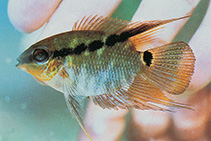
This species is distinguished by the lower metamerie meristics than its congeners: dorsal fin count usually XIV.ll instead of XV.l0-l1, anal fin count usually VILlI which is not found in other Mesonauta species, El row scales usually 24 instead of 25 or 26, vertebrae 13+13 instead of 12+14 or 13+14. Bar 6 is split ventrally, but unlike in M. mirificus with similar pattem, there are no horizontal stripes along the sides . It is distinguished from the geographically c!ose M. insignis also by deeper body (50.7-55.6%SL vs 47.6-53.4%SL) and shorter snout (8.9-11.0% vs 1O.2-13.0%SL), and by having plain coloured instead of reticulated dorsal pigment pattern (ref. 86444).
Body shape (shape guide): short and / or deep.
In shallow water among aquatic plants (Ref. 40602).
Cycle de vie et comportement reproducteur
Maturité | Reproduction | Frai | Œufs | Fécondité | Larves
Kullander, S.O. and A.M.C. Silfvergrip, 1991. Review af the South American cichlid genus Mesonauta Gunther (Teleostei, Cichlidae) with descriptions af two new species. Revue suisse Zoo!. 98(2):407-448. (Ref. 86444)
Statut dans la liste rouge de l'IUCN (Ref. 130435: Version 2025-2 (Global))
Menace pour l'homme
Harmless
Utilisations par l'homme
Outils
Articles particuliers
Télécharger en XML
Sources Internet
Estimations basées sur des modèles
Indice de diversité phylogénétique (Réf.
82804): PD
50 = 0.5078 [Uniqueness, from 0.5 = low to 2.0 = high].
Bayesian length-weight: a=0.02692 (0.01211 - 0.05983), b=3.02 (2.83 - 3.21), in cm total length, based on LWR estimates for this (Sub)family-body shape (Ref.
93245).
Niveau trophique (Réf.
69278): 3.3 ±0.4 se; based on size and trophs of closest relatives
Résilience (Réf.
120179): Haut, temps minimum de doublement de population inférieur à 15 mois (Preliminary K or Fecundity.).
Vulnérabilité de la pêche (Ref.
59153): Low vulnerability (10 of 100).
🛈