>
Eupercaria/misc (Various families in series Eupercaria) >
Haemulidae (Grunts) > Haemulinae
Etymology: Haemulon: Greek, haimaleos = bloody (Ref. 45335).
Umwelt: Milieu / Klimazone / Tiefenbereich / Verbreitungsgebiet
Ökologie
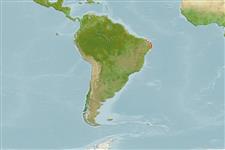
seewasser benthopelagisch; tiefenbereich 2 - 30 m (Ref. 37051). Tropical; 3°S - 10°S, 39°W - 34°W
Southwest Atlantic: Brazil, from off Fortaleza to the coast of Maceió.
Größe / Gewicht / Alter
Geschlechtsreife: Lm ? range ? - ? cm
Max length : 19.5 cm TL Männchen/unbestimmt; (Ref. 124459); max. veröff. Gewicht: 110.90 g (Ref. 124459)
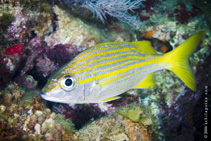
Rückenflossenstacheln (insgesamt) : 12; Rückenflossenweichstrahlen (insgesamt) : 14 - 16; Afterflossenstacheln: 3; Afterflossenweichstrahlen: 8 - 9. Distinguished from all other species of Haemulon by the following combination of characters: a black blotch below the free edge of the preopercle; pectoral fins entirely scaled, except along edge; scale rows below lateral line parallel to long axis of body; lower half of head silvery-white, lacking stripes; fins yellow; body silvery-white with 10-12 yellow stripes, the midlateral the broadest.
Body shape (shape guide): fusiform / normal; Cross section: oval.
Typically occurs in reefs, at depths of 2-30 m where it forms large schools during the day. Smaller schools, with less then 100 individuals, mostly juveniles, are seen on shallow reefs (2-6 m). At night the schools disperse to feed (Ref. 37051).
Lebenszyklus und Paarungsverhalten
Geschlechtsreife | Fortpflanzung | Ablaichen | Eier | Fruchtbarkeit | Larven
Oviparous, distinct pairing during breeding (Ref. 205).
Rocha, L.A. and I.L. Rosa, 1999. New species of Haemulon (Teleostei: Haemulidae) from the northeastern Brazilian coast. Copeia 1999(2):447-452. (Ref. 37051)
IUCN Rote Liste Status (Ref. 130435: Version 2025-2 (Global))
Bedrohung für Menschen
Harmless
Nutzung durch Menschen
Tools
Zusatzinformationen
Download XML
Internet Quellen
Schätzungen auf der Grundlage von Modellen
Bevorzugte Temperatur (Ref.
123201): 27.3 - 27.5, mean 27.5 °C (based on 27 cells).
Phylogenetischer Diversitätsindex (Ref.
82804): PD
50 = 0.5000 [Uniqueness, from 0.5 = low to 2.0 = high].
Bayesian length-weight: a=0.01259 (0.00753 - 0.02106), b=2.98 (2.84 - 3.12), in cm total length, based on LWR estimates for this species & Genus-body shape (Ref.
93245).
Trophische Ebene (Ref.
69278): 3.4 ±0.3 se; based on size and trophs of closest relatives
Widerstandsfähigkeit (Ref.
120179): hoch, Verdopplung der Population dauert weniger als 15 Monate. (Preliminary K or Fecundity.).
Anfälligkeit der Fischerei (Ref.
59153): Low vulnerability (10 of 100).
🛈